In April 2026 four people flew around the Moon for the first time in more than half a century and came home with thousands of photographs. These are five that we think will still be looked at in fifty years, with the frame numbers to find them.
By Joel Meter and Simon Phillipson. Last updated
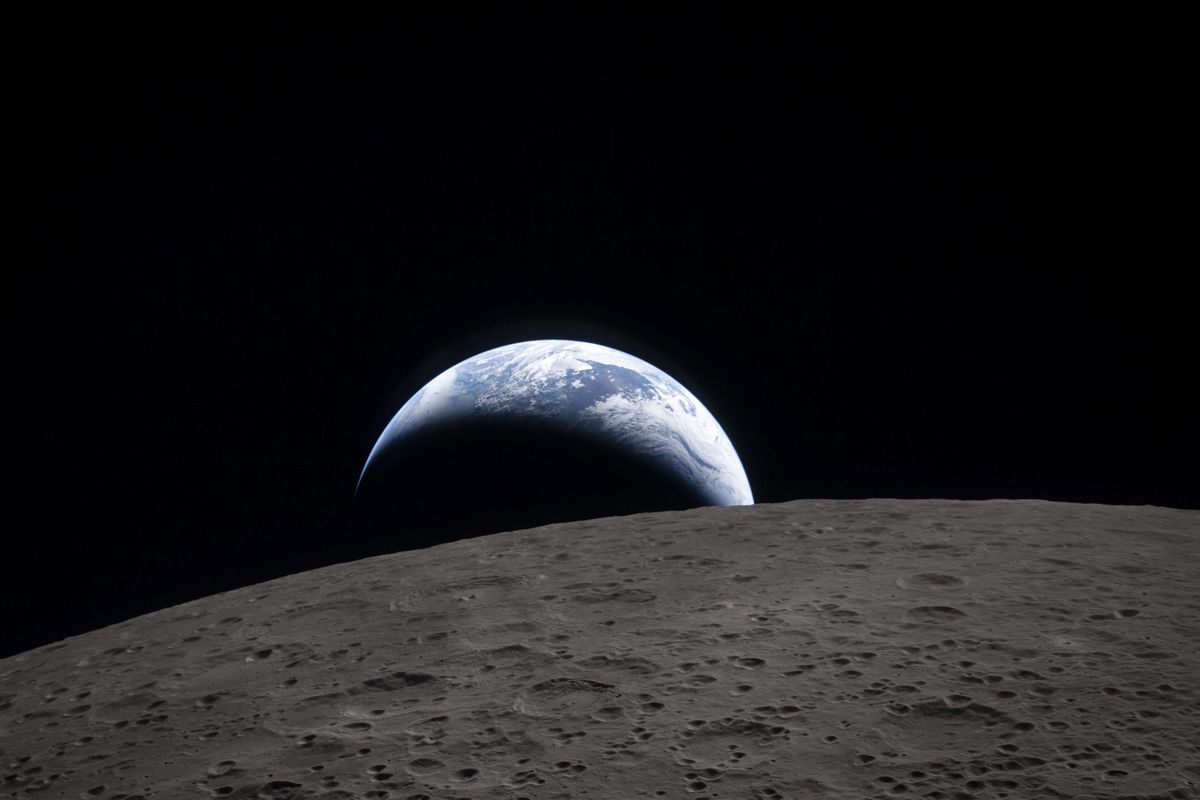
Earthset. Artemis II, 6 April 2026. Photo: NASA, Artemis II crew. Frame ART002E009288. Restored from the original mission data by Joel Meter and Simon Phillipson. The NASA Photo Book, pages 310 to 331.
In short
Artemis II flew four astronauts around the Moon in April 2026, the first people to leave Earth orbit since Apollo 17 in 1972. NASA has released more than 12,000 of their photographs, each with a frame number that begins ART002E. The one most often compared with Apollo 8's Earthrise is Earthset, frame ART002E009288, taken on 6 April 2026.
Key facts
CrewReid Wiseman, Victor Glover and Christina Koch of NASA, Jeremy Hansen of the Canadian Space Agency
SpacecraftOrion
Lunar flyby6 April 2026, closest pass about 6,545 kilometres (4,067 miles) from the Moon
Photographs releasedMore than 12,000, frame numbers beginning ART002E
Best known frameEarthset, ART002E009288
In the bookPages 310 to 331, Era 09, The Next Era of Seeing
On 1 April 2026, for the first time since Apollo 17 in 1972, people left Earth orbit. Reid Wiseman, Victor Glover, Christina Koch and Jeremy Hansen took the Orion spacecraft around the Moon, further from home than any crew had been before, and photographed its far side through the windows. On 6 April, the sixth day of the flight, they made their closest pass, about 6,545 kilometres (4,067 miles) from the Moon. Hansen flew for the Canadian Space Agency, the other three for NASA.
They photographed constantly. NASA has since released more than 12,000 of their pictures, each with a frame number that begins ART002E, for Artemis II. You can type any of the numbers on this page into NASA's image library and find the original. When the bulk release came out, the news galleries picked their favourites within days. This page is slower. It picks five frames that work as photographs, not just as news, and gives each one its NASA frame number, the date and what you are looking at, taken from NASA's own captions. Three of them show the Moon and Earth. Two show the people who made them.
1. Earthset
Frame ART002E009288, 6 April 2026, 6.41 pm EDT. Earth goes down behind the cratered lunar horizon, photographed through an Orion window as the crew swung around the far side. The dark half of the planet is in night. On the day side, swirling cloud lies over Australia and Oceania. In the foreground is Ohm crater, its walls terraced and its flat floor broken by central peaks, which formed when the surface rebounded after the impact.
Look at the shape of the Earth. Only part of it is lit, so it is not a full disc like the Blue Marble but a broad crescent, cut by the line between day and night. The Moon in front is sharp from edge to edge, every small crater on the horizon in focus, and the black above is clean. It is a very simple picture, two bodies and empty space.
It is the photograph from the flight that people will compare with Earthrise, and the comparison is fair. It is the same event, seen from the other side, and the picture at the top of this page is our restoration of it. For the full story of both photographs, see Earthrise, 1968, and Earthset, 2026.
2. Earth on the Moon's limb
Earth on the Moon's limb. Artemis II, 6 April 2026. Photo: NASA, Artemis II crew. Frame ART002E009287. Restored from the original mission data by Joel Meter and Simon Phillipson. The NASA Photo Book, pages 310 to 331.
Frame ART002E009287, the same minute. Here the camera pulls back and the whole curved edge of the Moon fills the frame, with a thin Earth sitting just above it. NASA's caption reads it like a map. Orientale basin is perched on the edge of the visible surface. Hertzsprung basin shows as two faint concentric rings, broken by the younger crater Vavilov. The lines of small pits are chains of secondary craters, thrown out by the impact that made Orientale.
It is a quieter picture than Earthset and in some ways a stranger one. The Moon here is enormous and the Earth is a sliver. Most of the frame is black.
3. The Moon in front of the Sun
The Moon in front of the Sun. Artemis II, 6 April 2026. Photo: NASA, Artemis II crew. Frame ART002E015967. Restored from the original mission data by Joel Meter and Simon Phillipson. The NASA Photo Book, pages 310 to 331.
Frame ART002E015967, also 6 April. From behind the Moon, the crew watched the Sun disappear behind it. Seen from Earth, a total eclipse lasts minutes, because the Moon and Sun look almost the same size in our sky. From Orion, so close to the Moon, it looked far bigger than the Sun, and the crew saw the Sun stay hidden for nearly an hour.
The soft glow around the black disc is zodiacal light, sunlight reflected by dust between the planets. The two bright points to the right of the Moon are Saturn and Mars.
4. Christina Koch in the window
Christina Koch in the window. Artemis II, April 2026. Photo: NASA, Artemis II crew. Frame ART002E008487. Editorial use only. The NASA Photo Book, pages 310 to 331.
Frame ART002E008487. Christina Koch, mission specialist, looks out of one of Orion's main cabin windows at Earth, early in the flight, on the way out to the Moon. Her face is in silhouette and the planet fills the window, blue and white and far too bright to be the light in the cabin.
It shows the simplest thing the crew did on the way out, which was look back. NASA's catalogue and our press materials give different days in early April for this frame, so we give the month only.
5. Koch and Glover at the window
Koch and Glover at the window. Artemis II, 6 April 2026. Photo: NASA, Artemis II crew. Frame ART002E025880. Editorial use only. The NASA Photo Book, pages 310 to 331.
Frame ART002E025880, 6 April 2026, the day of the lunar flyby. Christina Koch, below, and Victor Glover, above and upside down to the camera, share one window in the dim cabin. NASA's caption explains what they were doing. On flyby day the crew rotated roles, taking photographs, making annotations and recording what they saw of the surface.
It is a photograph of people working, not posing, and it belongs with a long line of pictures of astronauts at windows that runs back at least to Gemini. NASA does not allow current astronauts to appear in advertising, and the book's press pack limits these two crew photographs to editorial use. That is how they are used here.
Who were the Artemis II crew?
The Artemis II crew were Reid Wiseman, Victor Glover and Christina Koch of NASA and Jeremy Hansen of the Canadian Space Agency. On 1 April 2026 they became the first people to leave Earth orbit since Apollo 17 in 1972, and they took the Orion spacecraft around the Moon, further from home than any crew before them.
Did Artemis II photograph the far side of the Moon?
Yes. On 6 April 2026, the sixth day of the flight, the crew made their closest pass, about 6,545 kilometres from the Moon, and photographed its far side through Orion's windows. They rotated roles, taking photographs, making annotations and recording what they saw. NASA's captions name features such as Ohm crater and the Orientale and Hertzsprung basins.
Where can I find the original Artemis II photos?
NASA publishes the Artemis II photographs in its Image and Video Library and in the Artemis II gallery on nasa.gov. Every frame has a number that begins ART002E, for Artemis II, and typing any number on this page into the library finds the original. NASA has released more than 12,000 of the crew's pictures so far.
How are the Artemis II photos different from Apollo 8?
In 1968 Bill Anders had a Hasselblad loaded with film, a 250 mm lens and a few seconds of warning, and nobody could see the result until after splashdown. In 2026 the Artemis II crew flew digital cameras on a planned flyby and could check their pictures, and NASA released the first frames within a day.
Apollo 8 was the first crew to fly around the Moon, and its commander had not even scheduled the picture. The difference shows most in the numbers. Apollo 8 brought back a handful of Earthrise frames. Artemis II brought back thousands of pictures of the Moon, the Earth, the eclipse and each other.
What has not changed is what the photographs are for. Both crews spent their closest hours to the Moon looking back at Earth, and the pictures that will last from both flights are the ones of home. See Earthrise and Earthset side by side, and the Blue Marble, taken by the last crew to leave Earth orbit before this one.
In the book
The NASA Photo Book ends with Artemis II, on pages 310 to 331, in Era 09, The Next Era of Seeing. It is one of the first books to include the flight. The section includes the cratered edge of the Moon running across a spread with a thin crescent Earth beside it. The back of the book carries the words Victor Glover spoke to the people watching at home.
"Trust us, you look amazing. You look beautiful."
Victor Glover, Artemis II pilot, speaking to Earth from lunar distance, April 2026
The NASA Photo Book, pages 324 to 325. Artemis II.The NASA Photo Book, pages 326 to 327. Artemis II.