Photographs / Gemini 4Frame S65-34635
Ed White, the first American spacewalk, 3 June 1965
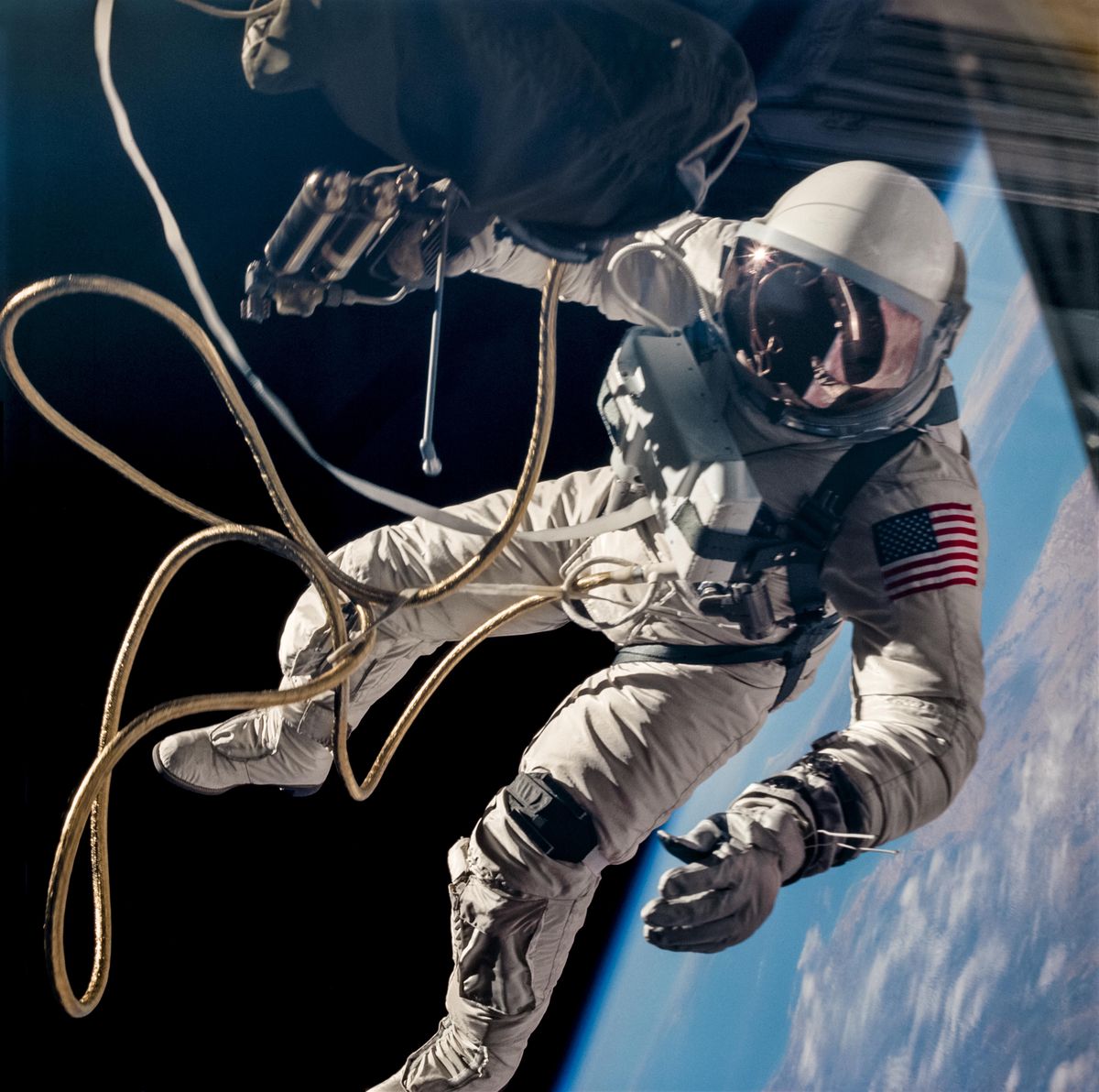
The first American to step outside a spacecraft, floating on a gold-wrapped cord above the clouds. The photograph was taken by the only other person within a few hundred kilometres, through the window of the capsule they had to get him back into.
By Joel Meter and Simon Phillipson. Last updated
In short
The photograph of Ed White floating above the clouds on 3 June 1965 shows the first American spacewalk, made during the third orbit of Gemini 4. His commander, James McDivitt, took it from inside the spacecraft, through his window. NASA catalogues it as frame S65-34635, one of nine frames from the spacewalk.
Key facts
- PhotographerJames McDivitt, commander of Gemini 4
- SubjectEd White, the first American to walk in space
- Date3 June 1965, third orbit
- MissionGemini 4
- NASA frameS65-34635, one of nine spacewalk frames
- In the bookPage 53, Era 01, Human Eyes in Space
When was the first American spacewalk?
Ed White made the first American spacewalk on 3 June 1965, during the third orbit of Gemini 4. He opened his hatch and used a handheld oxygen gun to push himself out into space, eleven weeks after the Soviet cosmonaut Alexei Leonov made the first spacewalk of all, from Voskhod 2 in March 1965.
He was attached to the spacecraft by a 25-foot umbilical and a 23-foot tether, both wrapped together in gold tape to make a single cord. That is the gold line looping through the photograph. On his chest he wore an emergency oxygen pack, and over his face a shaded visor against the unfiltered Sun. In his right hand he held what NASA called the Hand-Held Self-Maneuvering Unit, a small gun that fired jets of oxygen to push him in the direction he pointed it.
How long was Ed White's spacewalk?
NASA's own sources differ slightly. The caption for frame S65-34635 gives 21 minutes outside the spacecraft, and the National Space Science Data Center gives 23. White's oxygen gun ran out of fuel after about three minutes, so for most of that time he moved by twisting his body and hauling himself along the tether.
The gun worked while it lasted. According to the National Space Science Data Center he used it to travel out to the end of the tether and back to the spacecraft three times. The book calls it a spacewalk nobody wanted to end.
Getting back in was the hard part. A spare glove drifted away into orbit. Then the hatch would not latch, and White and his commander, James McDivitt, had to fight a mechanism that, left open, would have killed them both on reentry. They closed it.
Who took the photo of Ed White's spacewalk?
James McDivitt, the commander of Gemini 4, took the photographs from inside the spacecraft, through his window, while White worked a few metres away. The National Space Science Data Center lists nine frames from the spacewalk under NASA's S65 numbers. The best known, and the one shown on this page, is frame S65-34635.
The nine frames are S65-30427 to S65-30433, S65-34635 and S65-34642. The same numbers are used in NASA's image library today, so anyone can look up the whole series and compare the frames for themselves.
It is the one most people know for good reason. White is close and nearly whole in the frame, turned towards the camera, the gun in his hand and the gold cord sweeping out of the bottom of the picture. The flag on his left shoulder catches the light, and his visor reflects the spacecraft he has just left. Below him is the bright edge of Earth, broken cloud over blue, and the black above is completely empty. Nothing in the picture tells you how fast he is moving, or how far down that cloud is.
The NASA catalogue pages for these frames do not name the camera McDivitt used, and we have not found a primary NASA source that does. Rather than repeat a model number from secondary accounts, we leave it out here.
Restored
The restoration started from a scan of the original film. The rule is the same for every photograph in the book. Dust, scratches and fading come off, nothing is added that was never there, and the grain stays.
What happened to Ed White after Gemini 4?
Ed White did not live to fly in space again. He died with Gus Grissom and Roger Chaffee in the Apollo 1 fire at Cape Kennedy on 27 January 1967, less than two years after Gemini 4. For many people this photograph of him floating above the clouds on a gold-wrapped cord is how they know him.
Gemini 4 was the second crewed Gemini flight. Gemini 3 had flown less than three months earlier, in March 1965, the same month as Leonov's spacewalk.
Nineteen years after Gemini 4, Bruce McCandless did what White's oxygen gun had only hinted at, and flew free of the spacecraft with no tether at all. See Bruce McCandless, flying free. The two photographs make a pair, the first American outside a spacecraft and the first person with nothing holding him to one.
In the book
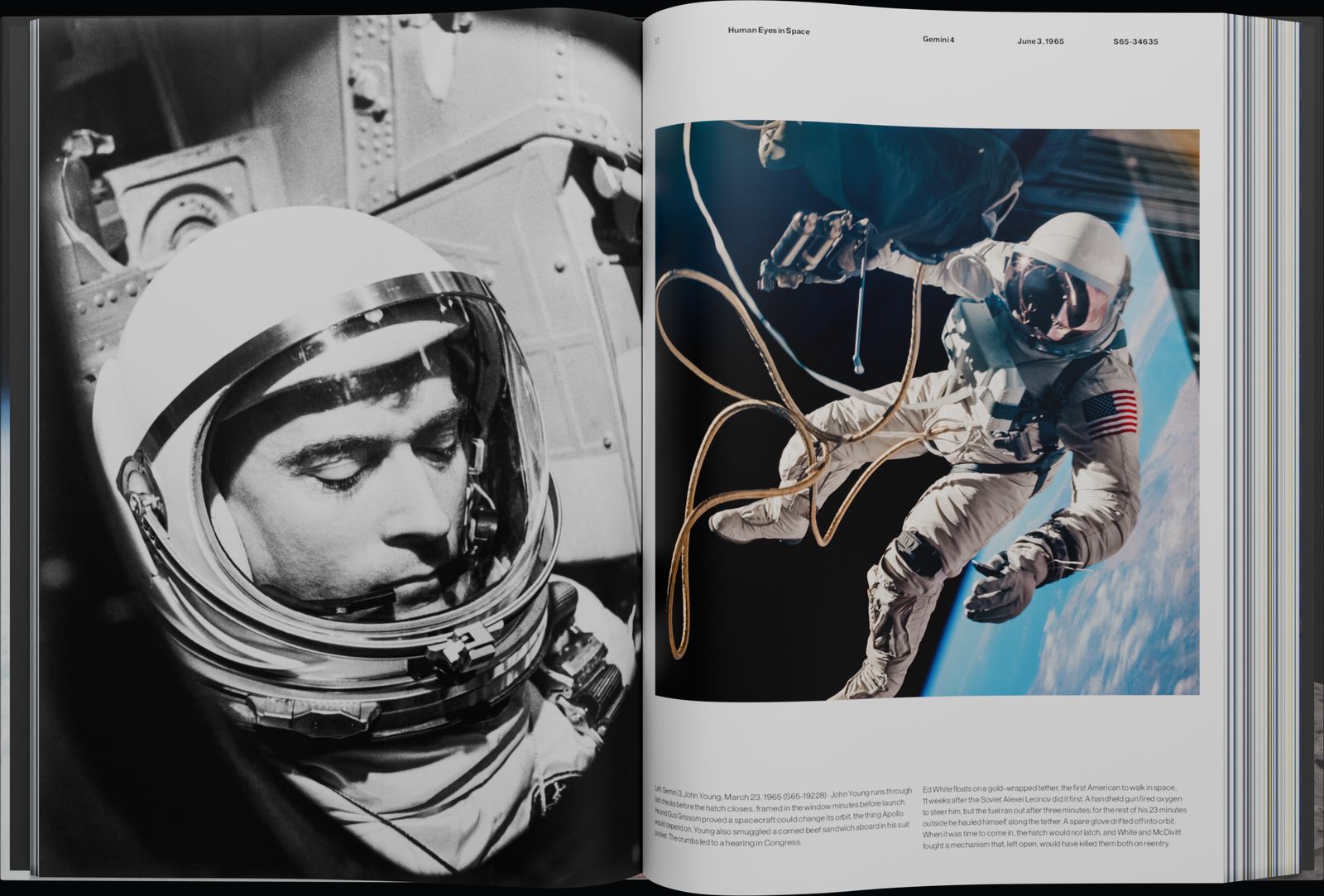
The NASA Photo Book prints the photograph on page 53, opposite John Young in his helmet on Gemini 3, in Era 01, Human Eyes in Space, which follows Mercury and Gemini from 1961 to 1966. Gemini runs through pages 50 to 62.
The facing page is a quieter picture. John Young runs through his last checks before launch on Gemini 3, framed in the window minutes before the hatch closes. On that flight he and Gus Grissom proved that a spacecraft could change its own orbit, the thing Apollo would depend on. Put together, the two pages show the two halves of the Gemini years, learning to fly the spacecraft and learning to leave it.
Elsewhere
For the other photographs that made the list, see the most famous NASA photographs, era by era. For the first photographs ever taken from above the atmosphere, nineteen years before this one, see the first photographs from space, in order.
Use this photograph
The original is public domain. If you use our restored version, please credit it like this and link to this page.
Photo: NASA, James McDivitt. Restoration: The NASA Photo Book (thenasaphotobook.com/photos/ed-white-spacewalk/)