Photographs / The canonTwenty photographs, 1946 to 2026
The most famous NASA photographs, era by era
Twenty photographs, ordered the way the book is ordered, by the way of seeing that made them. For each one, the frame number, the photographer where NASA records one, the date, and where it appears in the book.
Last updated
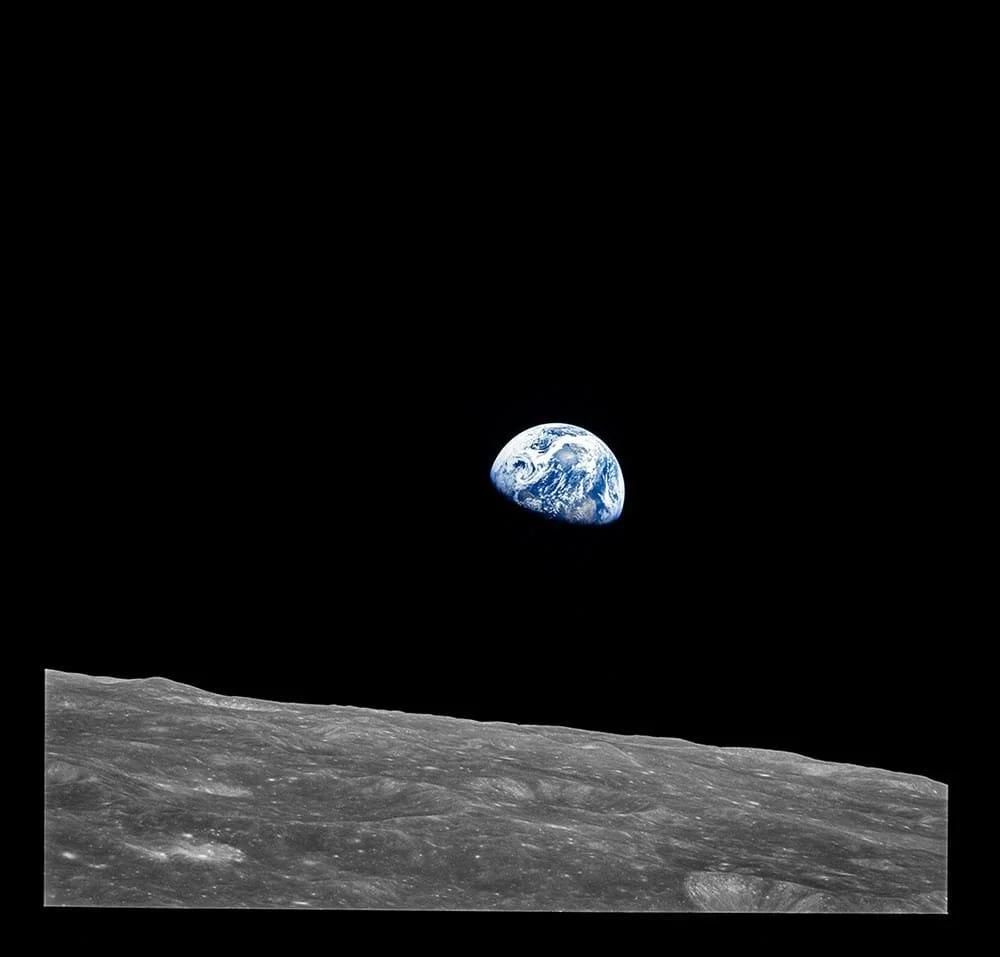
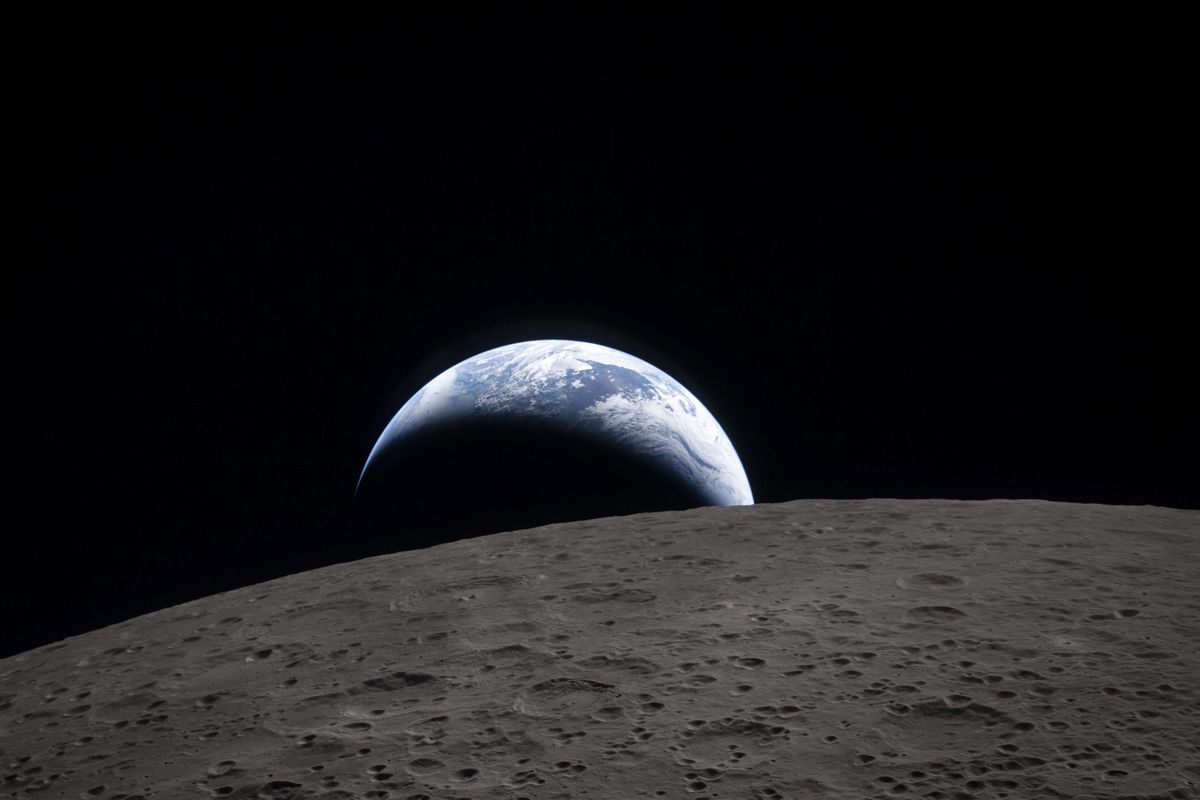
Earthrise. Apollo 8, 24 December 1968. Photo: NASA, Bill Anders. Frame AS08-14-2383. Restored from the original film scan, as published in Apollo VII–XVII. The NASA Photo Book, pages 82 to 83.
In short
The most famous NASA photographs include Earthrise from Apollo 8 in 1968, the Blue Marble from Apollo 17 in 1972, Ed White's spacewalk on Gemini 4 in 1965, Bruce McCandless flying free on STS-41B in 1984, Voyager 1's Pale Blue Dot in 1990 and Hubble's Deep Field and Pillars of Creation. Below are twenty, era by era, with frame numbers, photographers and dates.
Many lists of famous space photographs are a shuffle of telescopes and astronauts with no order and no names. This one follows the structure of The NASA Photo Book, which tells NASA's story in ten eras, each built around a new way of seeing. Inside each era the photographs are in order of date.
Every entry gives what NASA's own records give. The frame number, so you can find the original yourself. The photographer, where the record names one. The date, and the pages in the book. Fifteen of the twenty are shown here in the versions restored for the book or for its Apollo predecessor, cleaned of dust and fading, with the grain left in. The other five are linked to their official sources, either because the credit for our version is still being confirmed or because the photograph is not in the press set.
What are the most famous NASA photos?
The best known NASA photographs are Earthrise, taken by Bill Anders from Apollo 8 in 1968, and the Blue Marble, taken by the Apollo 17 crew in 1972. Others often named are Ed White's spacewalk, Bruce McCandless flying free, Voyager 1's Pale Blue Dot and Hubble's Pillars of Creation. All twenty are listed below.
Many were taken by astronauts. Bill Anders took Earthrise, James McDivitt photographed Ed White, Neil Armstrong photographed Buzz Aldrin on the ladder of Eagle and Robert Gibson photographed Bruce McCandless. NASA credits the Blue Marble to the Apollo 17 crew as a whole. Others were made by machines, from Voyager and Hubble to Curiosity and Webb.
Where can I find the original NASA photographs?
Every photograph on this list has a frame or image number, and the originals can be found by searching that number in the NASA Image and Video Library at images.nasa.gov. Planetary images carry PIA numbers, such as PIA01384 for Voyager 1's Jupiter. The Webb image of Pismis 24 is published by ESA/Webb under a CC BY 4.0 licence.
Era 00 / Before 1966Learning to Look
The first photograph of Earth from space, 24 October 1946
The first photograph of Earth from space. V-2 No. 13, 24 October 1946. Photo: U.S. Army, White Sands Missile Range. Restored by Joel Meter and Simon Phillipson. The NASA Photo Book, pages 25 to 27.
A captured V-2, rocket No. 13, climbed about 105 kilometres above New Mexico with a 35 mm motion picture camera in its nose. The rocket smashed on landing. The film, in a steel case, survived, and showed for the first time the curve of the planet under the black of space. It is not a NASA photograph, NASA did not yet exist, but it is where the story starts.
The first view of Earth from the Moon, 23 August 1966
The first view of Earth from the Moon. Lunar Orbiter 1, 23 August 1966. Photo: NASA/LOIRP, restored from the original data tapes in 2008. The NASA Photo Book, pages 32 and 150.
An unmanned mapping spacecraft, turned away from its job for one frame. Lunar Orbiter 1 photographed Earth rising over the Moon two years before any person saw it. For decades the picture was known only in a much coarser version. In 2008 NASA's Lunar Orbiter Image Recovery Project read it off the original data tapes, and that is the version in the book.
Era 01 / 1961 to 1966Human Eyes in Space
Ed White, the first American spacewalk, 3 June 1965
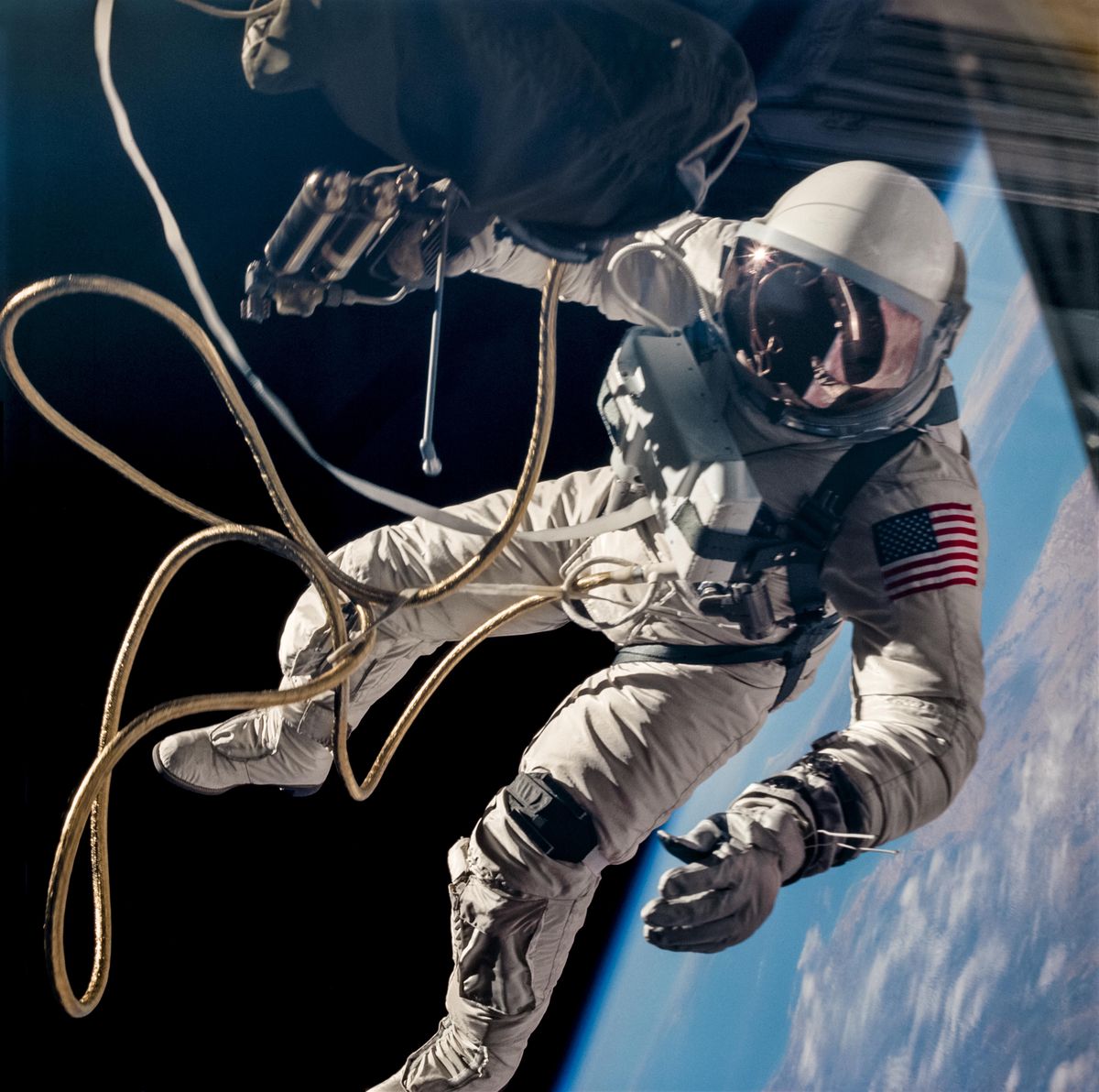
Ed White, the first American spacewalk. Gemini 4, 3 June 1965. Photo: NASA, James McDivitt. Frame S65-34635. Restored from the original film scan by Joel Meter and Simon Phillipson. The NASA Photo Book, page 53.
Frame S65-34635, taken by James McDivitt through the window of Gemini 4. White floats on a gold-wrapped cord with an oxygen gun in his hand, eleven weeks after Alexei Leonov made the first spacewalk. The gun ran dry in about three minutes and the hatch nearly would not close behind him.
Frame AS08-14-2383, by Bill Anders, on Apollo 8's fourth orbit of the Moon. He had just taken a black and white frame of the same view and called for colour film. For years the credit was confused. In 1987 the historian Andrew Chaikin settled it from the onboard tapes, and NASA's Scientific Visualization Studio later rebuilt the moment from orbital data. The photograph at the top of this page is the restored frame.
Buzz Aldrin on the porch of Eagle. Apollo 11, 20 July 1969. Photo: NASA, Neil Armstrong. Frame AS11-40-5866. Restored from the original film scan by Joel Meter and Simon Phillipson. The NASA Photo Book, pages 86 to 95.
Frame AS11-40-5866, taken by Neil Armstrong with the 70 mm lunar surface camera as Aldrin backed down the ladder of the lunar module. It is less famous than the portrait of Aldrin standing on the surface, but it is the moment between, Aldrin still on the ladder and not yet on the Moon. For the whole of the mission frame by frame, see Apollo 11, frame by frame.
The bootprint, 20 July 1969
The bootprint. Apollo 11, 20 July 1969. Photo: NASA. Frame AS11-40-5878. The NASA Photo Book, pages 86 to 95. View at NASA.
A close-up of an astronaut's bootprint in the lunar soil, AS11-40-5878, from the same magazine of film as the porch photograph. It became one of the symbols of the landing, a picture of the Moon with no Moon in it, only grey soil and the mark of a boot. The book keeps it with the rest of the Apollo 11 photographs.
The Blue Marble, 7 December 1972
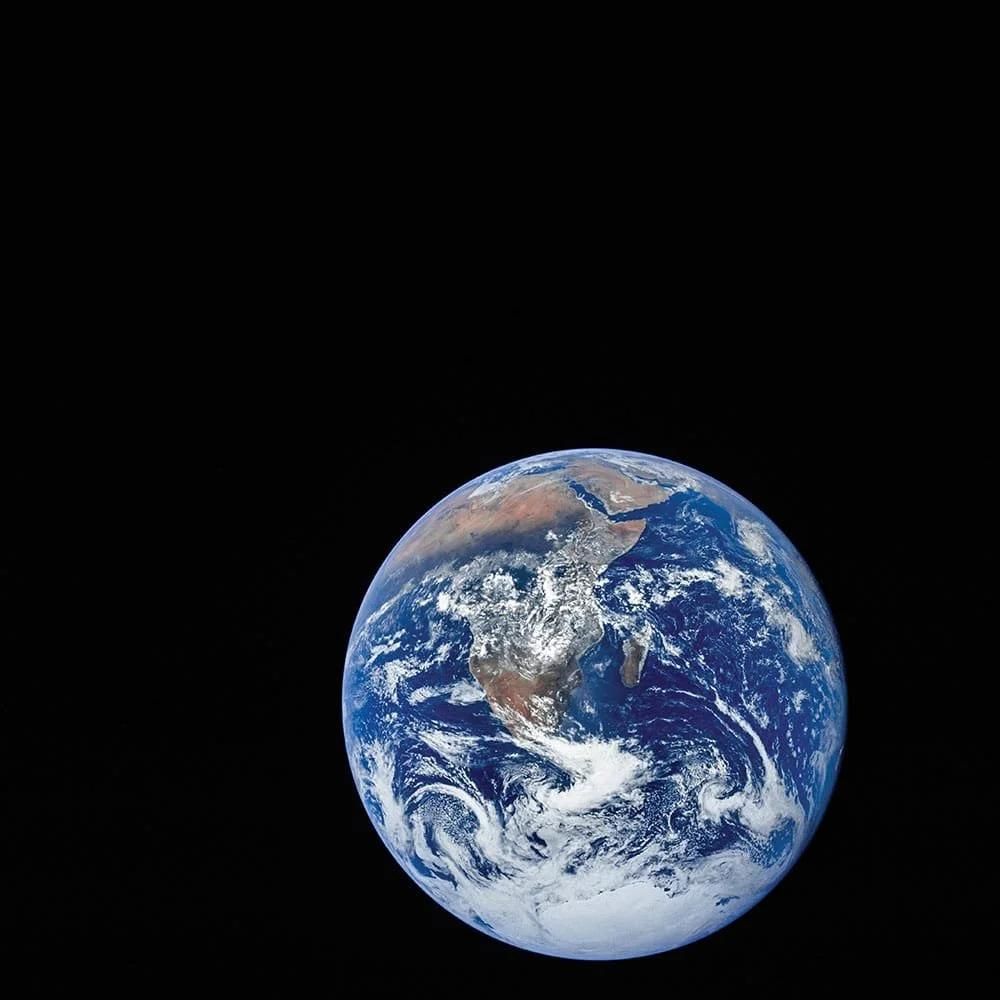
The Blue Marble, the full uncropped frame. Apollo 17, 7 December 1972. Photo: NASA, Apollo 17 crew. Frame AS17-148-22727. Restored from the original film scan, as published in Apollo VII–XVII. The NASA Photo Book, page 103.
Frame AS17-148-22727, about five hours after launch on the last Apollo flight, with the Sun behind the spacecraft lighting the planet edge to edge. NASA credits the crew of Cernan, Evans and Schmitt as a whole. The original has the South Pole at the top, and the famous version is turned and cropped. The version here is the full uncropped frame.
Edward Gibson in the airlock hatch. Skylab 4, February 1974. Photo: NASA. Frame SL4-150-5074. Restored from the original film scan by Joel Meter and Simon Phillipson. The NASA Photo Book, pages 112 to 117.
Frame SL4-150-5074. Edward Gibson, science pilot on the last Skylab crew, sails through the round hatch of the airlock module to show what zero gravity does, his arm raised as if waving. Around him are hoses, cables and stowed gear. It is a photograph of people living in space rather than visiting it, which is what Skylab was for.
Challenger rolling out in fog, 30 November 1982
Challenger rolling out in fog. Kennedy Space Center, 30 November 1982. Photo: NASA. Frame KSC-82PC-1325. Restored from the original film scan by Joel Meter and Simon Phillipson. The NASA Photo Book, pages 119 to 127.
Frame KSC-82PC-1325, from Kennedy Space Center. The new orbiter Challenger stands upright on its way to the pad, nearly swallowed by a bank of fog, with a tower rising out of the fog behind it. Most Shuttle photographs are about fire and noise. This one is silent.
Bruce McCandless flies free, 7 February 1984
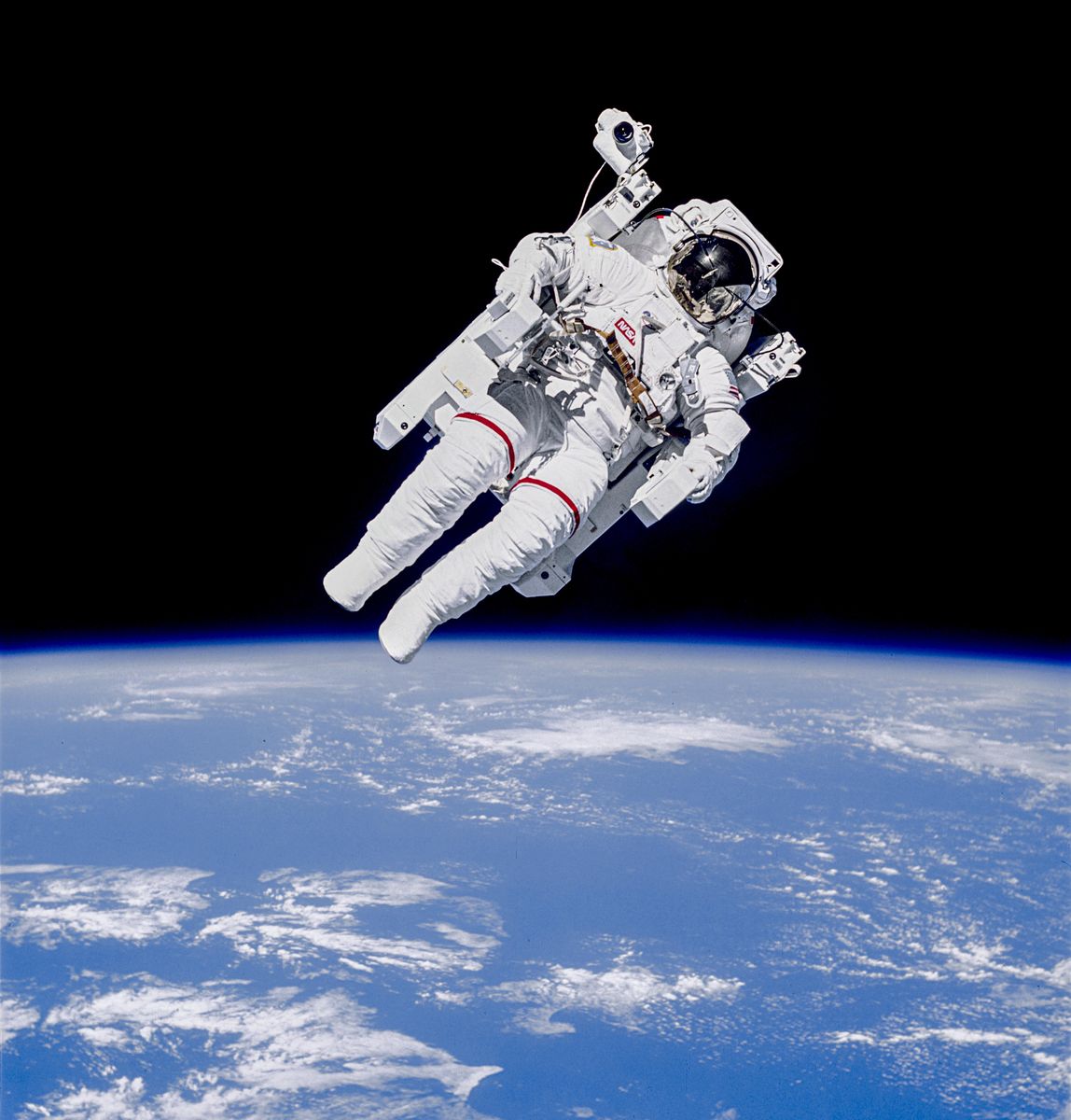
Bruce McCandless flies free. STS-41B, 7 February 1984. Photo: NASA, Robert Gibson. Frame STS41B-35-1613. Restored from the original film scan by Joel Meter and Simon Phillipson. The NASA Photo Book, cover and page 124.
Frame STS41B-35-1613, taken by the pilot Robert Gibson from inside Challenger. McCandless is flying the Manned Maneuvering Unit, a nitrogen-jet backpack, with nothing connecting him to the shuttle, the first person to move through space untethered. It is the cover of the book.
Atlantis docked to Mir. STS-71, July 1995. Photo: NASA. Frame STS071-741-004. Restored from the original film scan by Joel Meter and Simon Phillipson. The NASA Photo Book, page 130.
Frame STS071-741-004, a fisheye view through a window of Mir's Kvant 2 module, with the nose of the shuttle Atlantis docked below and a half globe of Earth behind it. NASA's caption notes the Crimean Peninsula in the background. STS-71 was the first time a Space Shuttle docked with Mir.
Era 04 / 1964 to 1990Machines as Eyes
Jupiter's Great Red Spot, February 1979
Jupiter's Great Red Spot. Voyager 1, February 1979. Photo: NASA/JPL. Image PIA01384. Restored from the original mission data by Joel Meter and Simon Phillipson. The NASA Photo Book, pages 158 to 164.
Image PIA01384, from Voyager 1's approach to Jupiter. Voyager's cameras recorded in black and white. The picture was assembled at the Jet Propulsion Laboratory from three black and white frames taken through colour filters. The storm in the upper right is larger than Earth.
Pale Blue Dot, February 1990
Pale Blue Dot. Voyager 1, February 1990. Photo: NASA/JPL-Caltech. Images PIA00452 and PIA23645. The NASA Photo Book, pages 158 to 164. View at NASA JPL.
Part of the first portrait of the solar system, 60 frames taken by Voyager 1 from more than four billion miles away. Earth is a point of light smaller than a single pixel, caught by chance in a band of scattered sunlight. In 2020, for the thirtieth anniversary, JPL reprocessed the frame with modern software as PIA23645.
Era 05 / 1981 to 2020Above the Air
Hubble Deep Field, December 1995
Hubble Deep Field. Hubble Space Telescope, December 1995. NASA, ESA and STScI. The NASA Photo Book, pages 178 to 197. View at NASA.
For about ten days at the end of 1995 Hubble stared at a patch of sky near the Big Dipper that looked empty, a field a fraction of the width of the full Moon. The 342 exposures showed it held thousands of galaxies, some seen as they were billions of years ago.
Pillars of Creation, 1995 and 2014
Pillars of Creation. Hubble Space Telescope, 1995 and 2014. NASA, ESA and STScI. The NASA Photo Book, pages 178 to 197. View at NASA.
Three columns of cold gas in the Eagle Nebula, about 6,500 light years away, lit by young stars. Hubble first photographed them in 1995 and returned in late 2014 with a newer camera, for a sharper and wider view released for its 25th anniversary. Comparing the two showed changes in a jet from one of the new stars inside.
Era 06 / 1976 to 2026Asking the Rocks
The first photograph on the surface of Mars, 20 July 1976
First photograph on the surface of Mars. Viking 1, 20 July 1976. Photo: NASA/JPL. Image PIA00381. The NASA Photo Book, pages 208 to 211. View at NASA.
Taken minutes after Viking 1 landed. Rocks and sand close up, and at the right edge, part of the lander's own footpad, with a little dust thrown onto it by the landing. The first thing a machine did on Mars was look at its own feet.
Curiosity beside Namib Dune. Mars, 19 January 2016. Photo: NASA/JPL-Caltech/MSSS. Image PIA20316. Restored from the original mission data by Joel Meter and Simon Phillipson. The NASA Photo Book, page 226.
Image PIA20316, a self-portrait stitched from 57 frames taken by the camera on the end of the rover's arm. Behind Curiosity is the dark sand of Namib Dune, part of a dune field that moves up to about a metre a year.
Era 07 / 1989 to 2024The Patient Machines
Pluto, seen up close, 14 July 2015
Pluto, seen up close. New Horizons, 14 July 2015. Photo: NASA/JHUAPL/SwRI. Image PIA19952, enhanced colour. The NASA Photo Book, page 259.
Image PIA19952, from New Horizons' flyby, nine and a half years after launch. The colours are enhanced from blue, red and infrared images to show the differences between regions of the surface, and the detail goes down to about 1.3 kilometres.
Era 09 / 2021 to 2026The Next Era of Seeing
Pismis 24 in the Lobster Nebula, released 4 September 2025
Pismis 24 in the Lobster Nebula. James Webb Space Telescope, released 4 September 2025. Credit NASA, ESA, CSA, and STScI, A. Pagan (STScI), CC BY 4.0, ESA/Webb, processing The NASA Photo Book. Image weic2518a. The NASA Photo Book, pages 304 to 308.
A cluster of young stars and the clouds of gas and dust they are carving, photographed by the James Webb Space Telescope's near-infrared camera. Webb sees in infrared, beyond the range of the eye, so every colour in the picture is a translation. Its credit is the full ESA/Webb credit under the CC BY 4.0 licence.
Earthset, 6 April 2026
Earthset. Artemis II, 6 April 2026. Photo: NASA, Artemis II crew. Frame ART002E009288. Restored from the original mission data by Joel Meter and Simon Phillipson. The NASA Photo Book, pages 310 to 331.
Frame ART002E009288, taken through an Orion window by the Artemis II crew as they flew around the far side of the Moon, the first people to leave Earth orbit since 1972. Earth sets behind the crater Ohm. It is the answer to Earthrise, and the newest photograph on this list.
No list of twenty can hold NASA's photography. Apollo alone produced thousands of frames, and the best of them are on the Apollo VII–XVII site, Apollo VII–XVII, mission by mission. The International Space Station, Era 08, has eight million photographs of Earth and deserves its own page. Many more are in the book, which runs to 336 pages and more than 340 photographs, from the first rockets to Artemis II. For the eras themselves, see the ten eras of the book.