Photographs / Apollo 8 and Artemis IIFrame AS08-14-2383
Earthrise, 1968, and Earthset, 2026
Two photographs of the same event, fifty-seven years apart. One was taken on film by a man who was not supposed to be taking pictures of Earth at all. The other was made on a digital camera by a crew who had flown around the Moon partly to take it.
By Joel Meter and Simon Phillipson. Last updated
In short
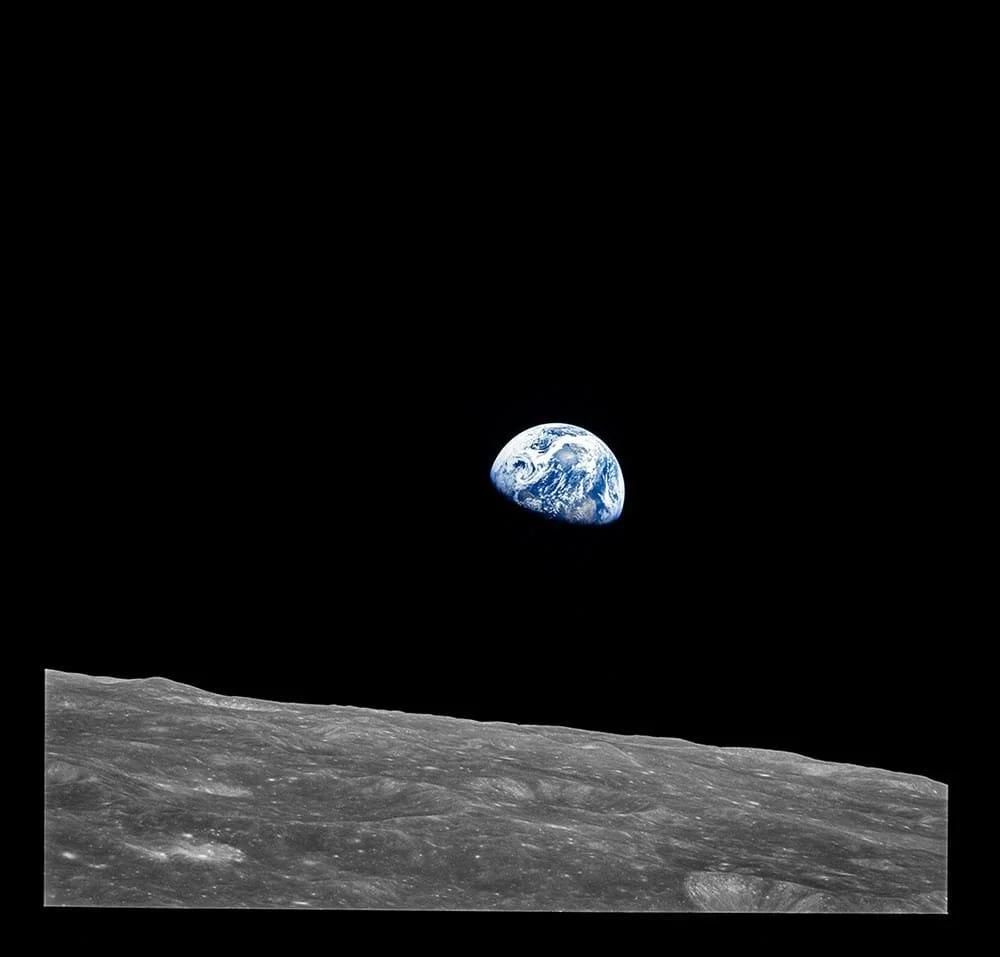
Earthrise is the photograph of Earth rising over the Moon that Bill Anders took from Apollo 8 on 24 December 1968, as the spacecraft came around the far side of the Moon on its fourth orbit. NASA catalogues the colour frame as AS08-14-2383. It became one of the most reproduced photographs ever made, and in April 2026 the Artemis II crew answered it with Earthset.
Key facts
- PhotographerBill Anders, Apollo 8
- Date24 December 1968, a little after 10.30 am Houston time
- MissionApollo 8, fourth orbit of the Moon
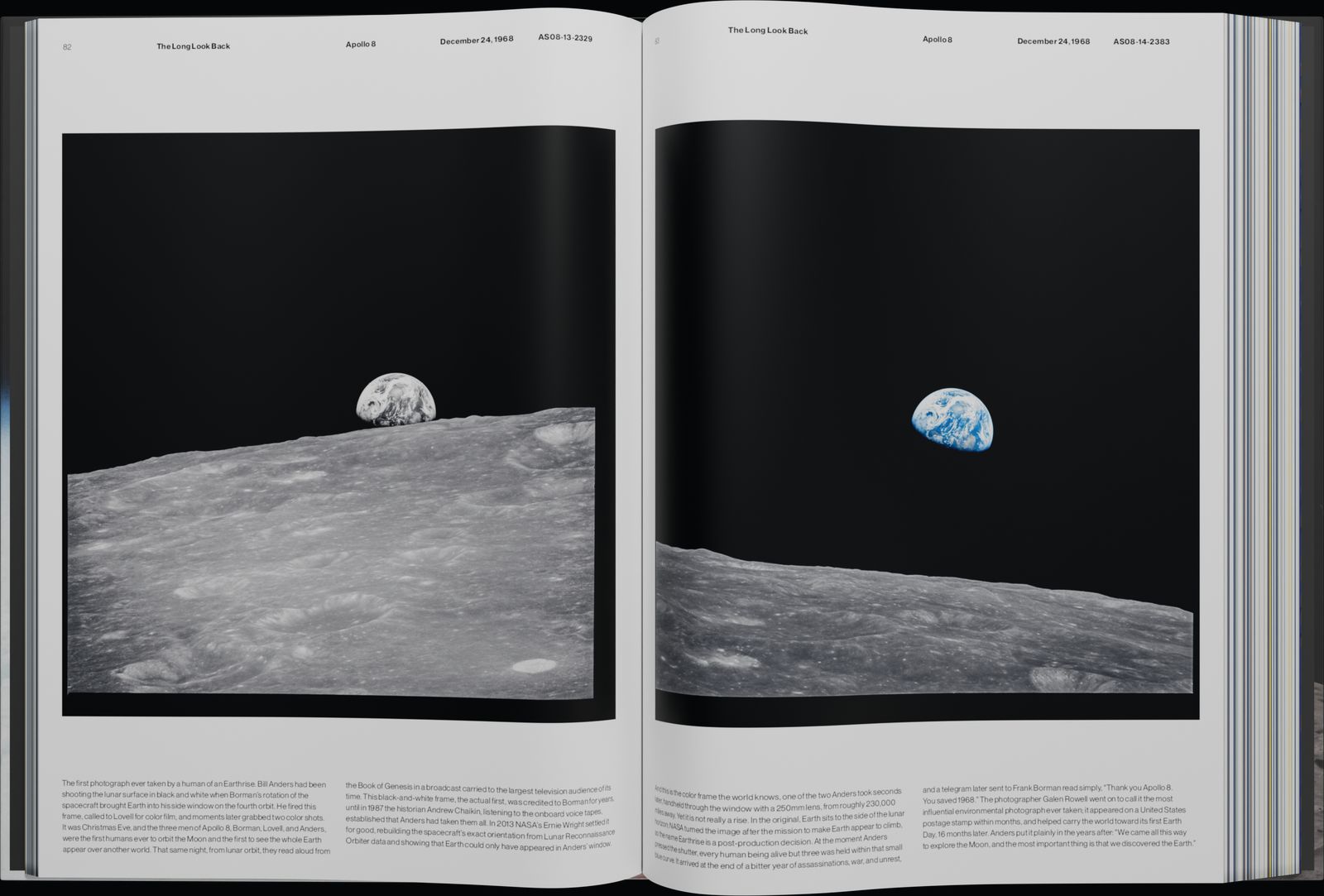
- NASA frameAS08-14-2383 (colour), AS08-13-2329 (black and white)
- CameraHasselblad with a 250 mm telephoto lens, 1/250 second at f/11
- In the bookPages 82 to 83, Era 02, The Long Look Back
When was the Earthrise photo taken?
Bill Anders took Earthrise on 24 December 1968, a little after 10.30 am Houston time, as Apollo 8 came around the far side of the Moon for the fourth time. Earth stood about five degrees above the lunar horizon, which was about 570 kilometres from the spacecraft. It had also risen, unseen, on the three orbits before.
Frank Borman was rolling the spacecraft, and as it turned, Earth slid into view in Bill Anders's side window, rising over a horizon of grey craters.
NASA's own caption for frame AS08-14-2383 gives the rest of the geometry. The horizon lies near 110 degrees east longitude, and the strip of Moon in the frame is about 150 kilometres wide. On Earth, the line between day and night is crossing Africa, the South Pole sits in the white area at the left end of that line, and the Americas are under cloud.
What camera was used to take Earthrise?
Earthrise was made by hand, through a window of Apollo 8, with a Hasselblad camera and a 250 mm telephoto lens. Jim Lovell read out the exposure for Bill Anders, one two-hundred-fiftieth of a second at f/11. Anders first fired one black and white frame, then called for a magazine of colour film for the famous frame.
Is Earthrise shown the way it was taken?
Not quite. In the frame as Bill Anders exposed it, Earth sits to the side of the lunar horizon. NASA later turned the picture so that Earth appears to climb, so the name Earthrise is a decision made on the ground. The version on this page and in the book is the familiar turned one.
Who took the Earthrise photo?
Bill Anders took the Earthrise photograph from Apollo 8. For years the black and white frame was credited to Frank Borman, but in 1987 the historian Andrew Chaikin established from the onboard voice tapes that Anders had taken all of the Earthrise frames. NASA's Scientific Visualization Studio later confirmed it by rebuilding the spacecraft's orientation from orbital data.
Anders had been photographing the lunar surface in black and white. When Earth appeared, he fired one frame on the black and white magazine, AS08-13-2329, then called to Lovell for a magazine of colour film. On the onboard recording Borman tells him not to take it, because it is not scheduled. Moments later Anders had two colour frames. AS08-14-2383 is the one the world knows.
In 2012 and 2013 Ernie Wright at NASA's Scientific Visualization Studio rebuilt the spacecraft's orientation from Lunar Reconnaissance Orbiter data and the mission's voice recording, and showed that Earth could only have appeared in Anders's window at that moment. The question of who held the camera has been closed since. Every one of the three Earthrise frames from that orbit was made by Anders.
Anders put the meaning of it plainly in the years after. "We came all this way to explore the Moon, and the most important thing is that we discovered the Earth."
Restored, not retouched
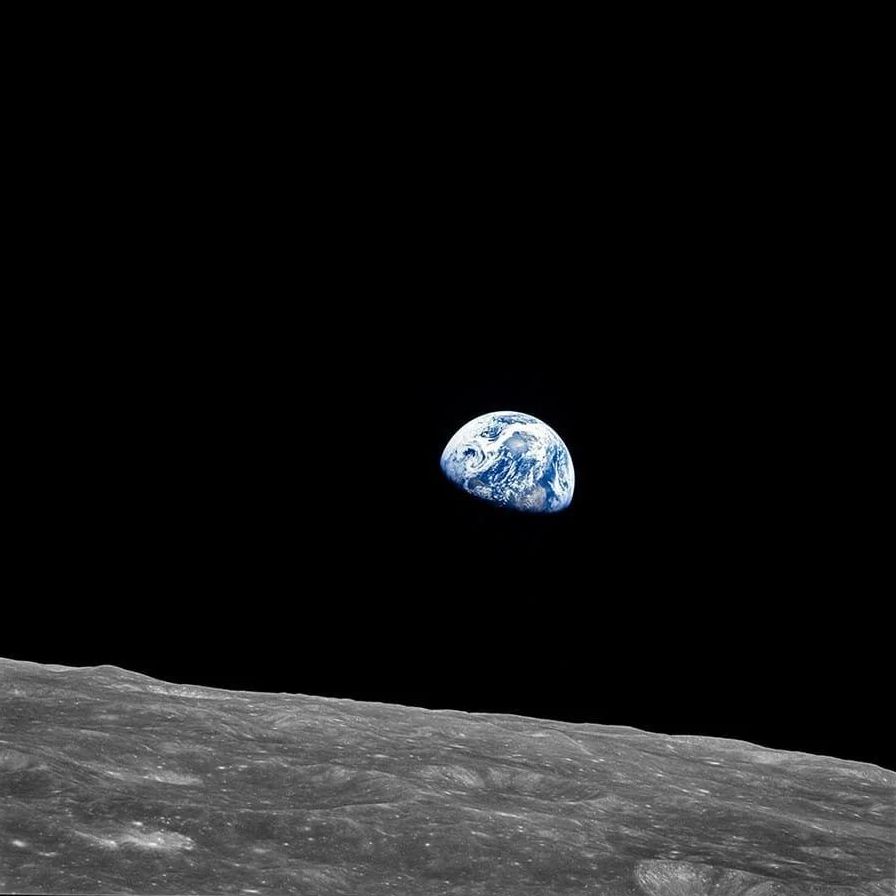
The colour frame shown at the top of this page is the restoration first made for Apollo VII–XVII, the Apollo photo book by the same authors. Below, the same frame is laid over the archive scan that NASA distributes through its image library. Drag the line to compare them. The scan is a faithful record of the film, but it is lighter and flatter, and the lunar surface loses most of its depth. In the restoration the blacks are black again and the ridges and craters along the horizon regain their shape.
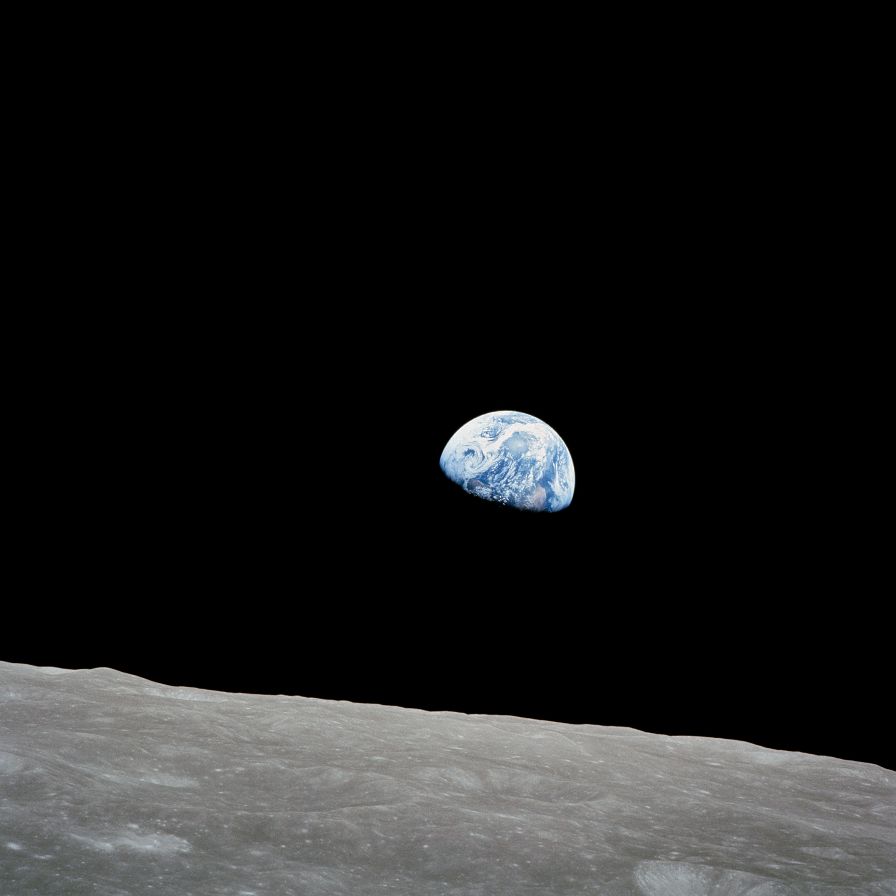
Restored. Frame AS08-14-2383, cropped to the area of the archive scan.
Archive scan. Frame AS08-14-2383 as distributed by NASA Johnson Space Center, aligned to the restored frame. Source, NASA Image and Video Library.
The rule for every photograph in the book is the same. Dust, scratches and fading come off. Nothing is added that was never on the film. The grain stays, because the grain is the proof that a person was there with a camera. The aim is to get back to what the emulsion recorded, not to improve on it.
Is there an Earthrise photo from Artemis II?
Yes. On 6 April 2026, at 6.41 pm EDT, the Artemis II crew photographed Earth going down behind the Moon from a window of their Orion spacecraft. NASA catalogues it as frame ART002E009288, known as Earthset. It is the same event as Earthrise seen from the other direction, with Earth setting rather than rising over the lunar limb.
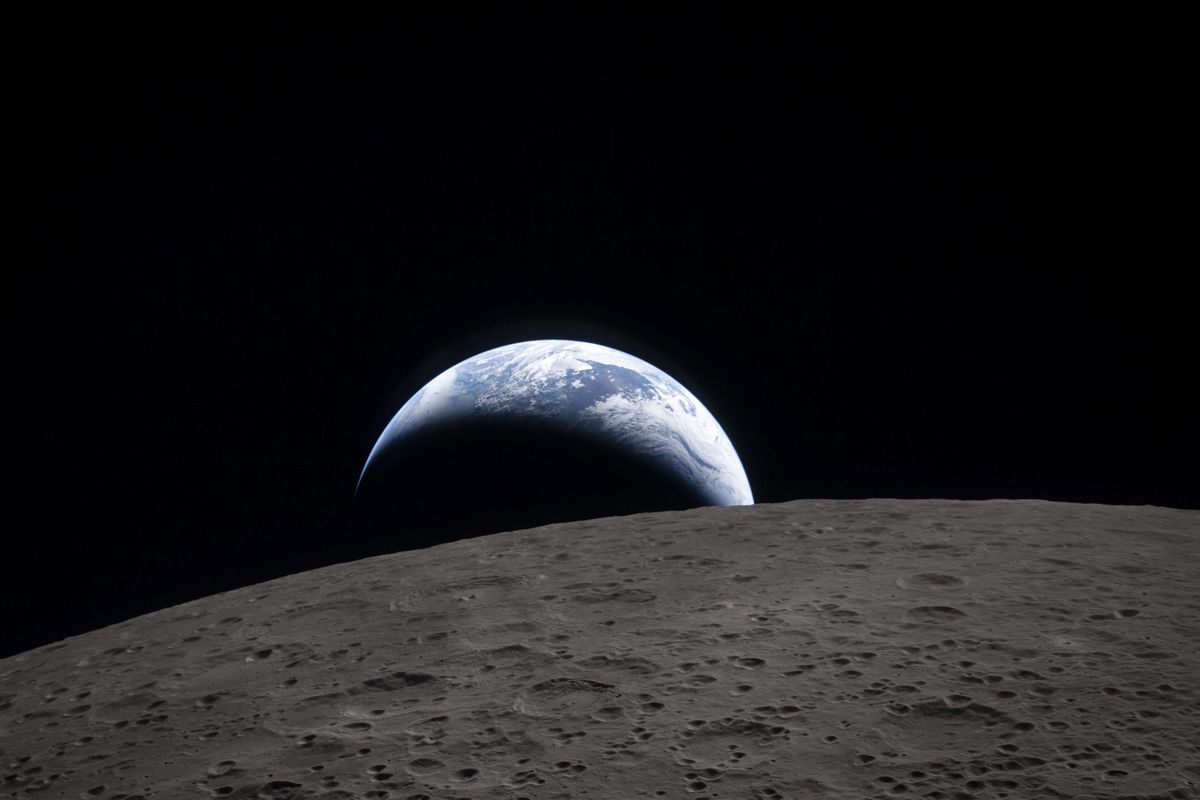
NASA's caption describes a muted blue Earth with bright white clouds, its dark half in night and its day side showing swirling cloud over Australia and Oceania. The crater in the foreground is Ohm, with terraced walls and central peaks. A second frame from the same minute, ART002E009287, pulls back to show the whole curved limb of the Moon, with the old Orientale basin on its edge and a thin Earth just above it.
Put the two pictures side by side and the differences are as interesting as the likeness. In 1968 one man had a handheld camera, a few seconds, and film that would not be seen until the crew came home. In 2026 four people had digital cameras, a planned flyby and time to choose their frames, and the first pictures were released within a day. What did not change is the scale. In both, the whole of human history fits in a small blue shape over a grey horizon, and the people who made the picture were the only ones not in it.

During the flyby Victor Glover spoke to the people watching at home. His words are printed on the back of the book.
"Trust us, you look amazing. You look beautiful."
Victor Glover, Artemis II pilot, speaking to Earth from lunar distance, April 2026
In the book
In The NASA Photo Book, Earthrise opens on pages 82 to 83, with the black and white frame Anders took first on the left and the colour frame on the right. It sits in Era 02, The Long Look Back. Earthset and the other Artemis II photographs close the book on pages 310 to 331.
Elsewhere
For Apollo 8 in depth, see the restored frames of Apollo 8 on the Apollo VII–XVII site. If you want the picture on a wall, there is Earthrise as a print. For the photograph Apollo 17 made four years later, read about the Blue Marble. For what came before Apollo 8, see the first photographs from space, and for the rest of the 2026 flight, the Artemis II photographs.
Use this photograph
The original is public domain. If you use our restored version, please credit it like this and link to this page.
Photo: NASA, Bill Anders. Restoration: The NASA Photo Book (thenasaphotobook.com/photos/earthrise/)