Photographs / Apollo 17Frame AS17-148-22727
The Blue Marble, 7 December 1972
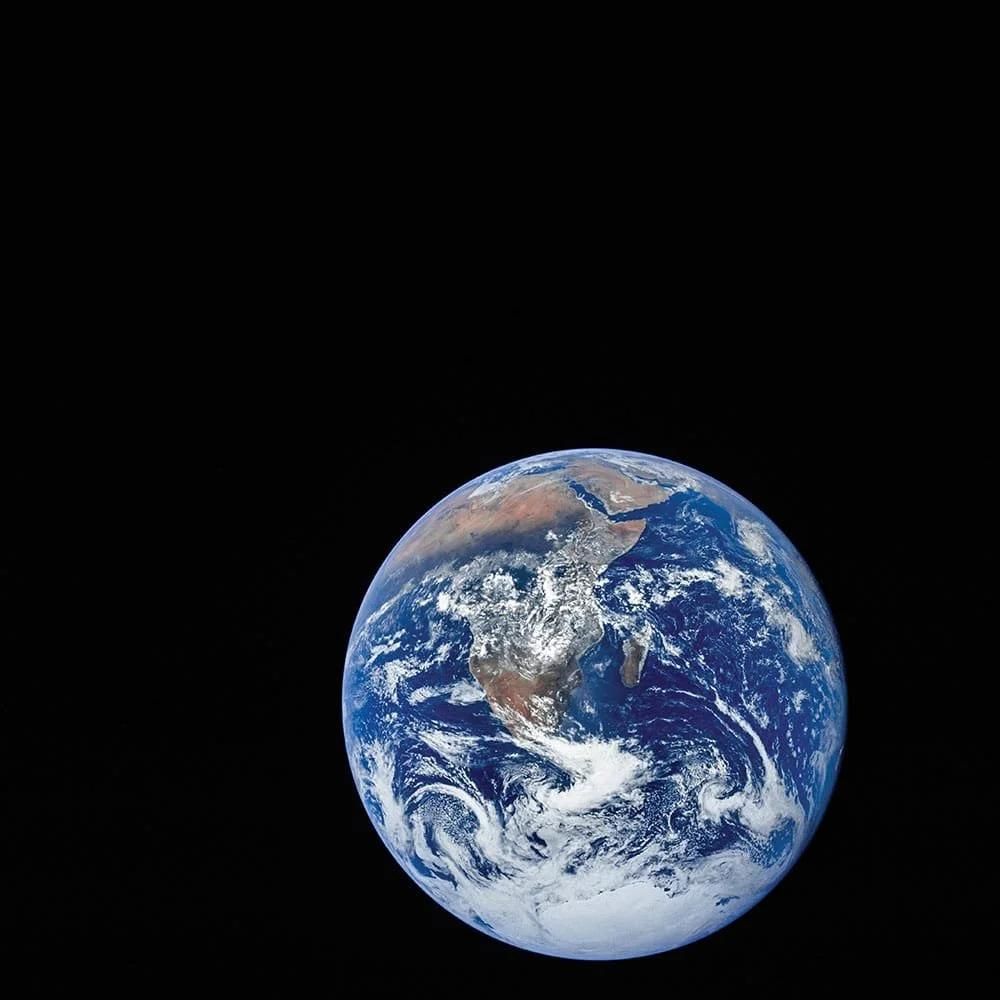
The most reproduced photograph of Earth was taken on the way out to the Moon by a crew who never agreed on which of them took it. NASA turned it the right way up before anyone saw it.
By Joel Meter and Simon Phillipson. Last updated
In short
The Blue Marble is the photograph of the whole, fully lit Earth taken by the crew of Apollo 17 on 7 December 1972, about five hours after launch on the last crewed flight to the Moon. NASA catalogues it as frame AS17-148-22727 and credits the crew of Eugene Cernan, Ronald Evans and Harrison Schmitt as a whole. It is the most reproduced photograph of Earth.
Key facts
- PhotographerApollo 17 crew, Eugene Cernan, Ronald Evans and Harrison Schmitt
- Date7 December 1972, about five hours after launch
- MissionApollo 17, command module America
- NASA frameAS17-148-22727
- Film70 mm colour film, through a window
- In the bookPage 103, Era 02, The Long Look Back
When was the Blue Marble photo taken?
The Blue Marble was taken on 7 December 1972, about five hours after Apollo 17 launched on the last crewed flight to the Moon. With the command module America on its way out, the crew photographed the whole planet through a window on 70 mm colour film. NASA's catalogue lists the frame as AS17-148-22727.
Two things came together that day. The Sun was almost directly behind the spacecraft, so the side of Earth facing the crew was lit all the way across, with no shadow on its edge. And the path of the flight let them see far enough south to photograph the Antarctic ice cap, something no earlier Apollo crew had been able to do. NASA's caption calls it the first time the Apollo trajectory made the south polar ice cap visible.
What does the Blue Marble photo show?
The view in NASA's caption runs from the Mediterranean to the Antarctic ice cap. Almost the whole coastline of Africa is clear, with the Arabian Peninsula at its northeast corner and Madagascar off the east coast. A cyclone turns over the Indian Ocean, and the Southern Hemisphere is heavy with cloud.
The caption was written in 1972 and it shows. It calls Madagascar the Malagasy Republic, the name the country used at the time. In this frame the planet is round and lit edge to edge, and it is all there.
Who took the Blue Marble photo?
NASA credits the Blue Marble to the Apollo 17 crew as a whole, Eugene Cernan, Ronald Evans and Harrison Schmitt, and has never named one photographer. Interviews and evidence examined by the Apollo historian Eric Hartwell point to Schmitt as the most likely photographer, and Evans has also been named. The NASA Photo Book follows NASA and credits the crew.
The crew were Eugene Cernan, the commander, Ronald Evans, the command module pilot, and Harrison Schmitt, the lunar module pilot. Naming no single photographer is NASA's practice for most mission photographs, and nothing in the primary record names one man.
It also matters less than it seems. The frame is the third of three nearly identical exposures and any of the three could have become the famous one. What made it famous was the light, the angle and the timing, more than the hand on the shutter.
Why is the Blue Marble upside down?
As the crew saw it, and as the film recorded it, the South Pole was at the top. A spacecraft has no up or down. When NASA released the picture it turned the frame so that north was up and cropped it close around the disc. That turned version is the one most people know.
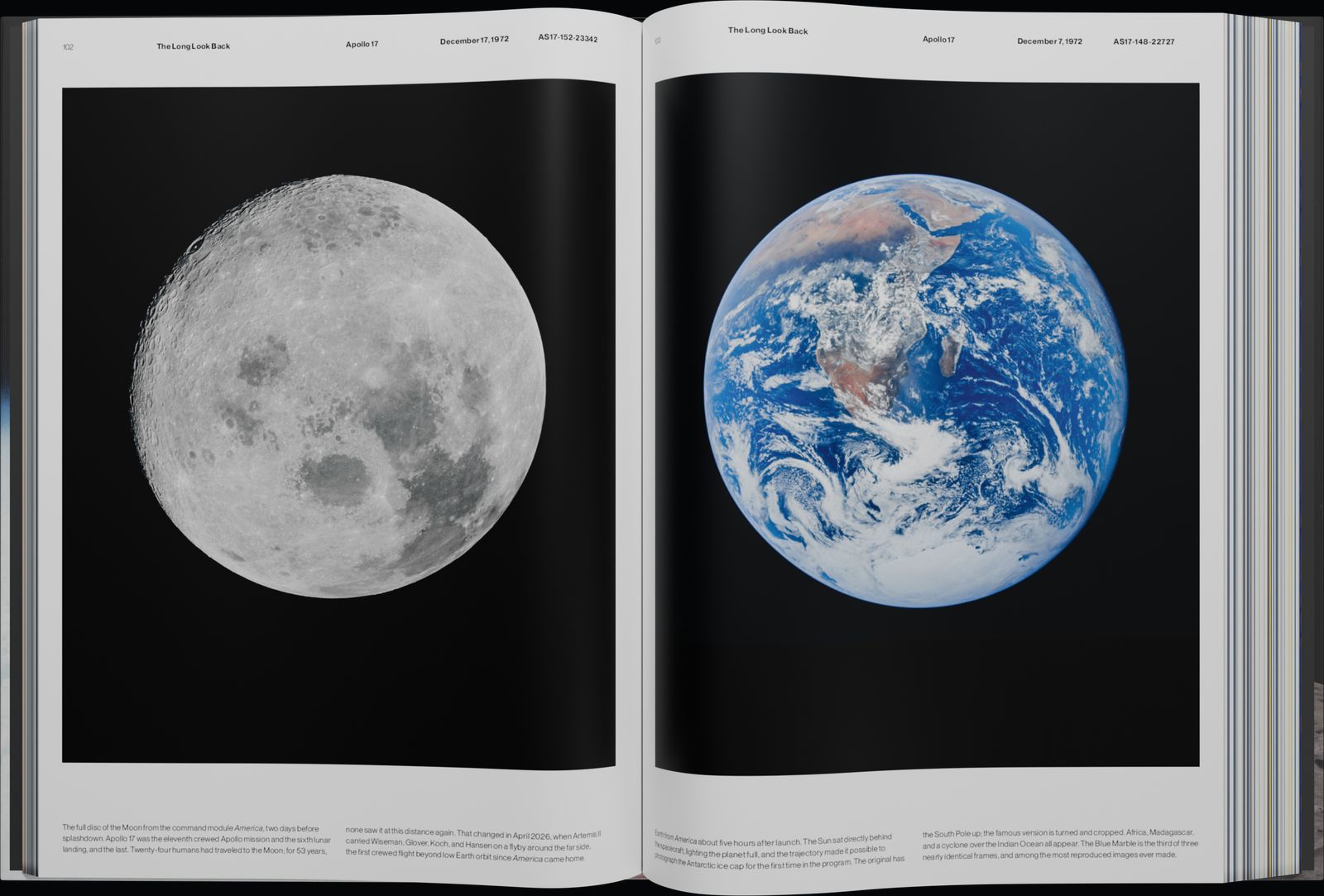
The book prints it the familiar way round on page 103, opposite a full Moon photographed by the same crew ten days later on their way home. The version at the top of this page shows the full frame from the original film, uncropped, with Earth sitting low in the corner of a large black square. It is a useful reminder of how small the planet was in the viewfinder.
Restored
The restoration shown here is the one first made for Apollo VII–XVII, the Apollo photo book by the same authors. The approach is the one used for every photograph in the book. Start from the best surviving scan of the original film. Take off the dust, the scratches and the fading. Add nothing that was never there, and leave the grain, because the grain is the proof that someone was there holding the camera.
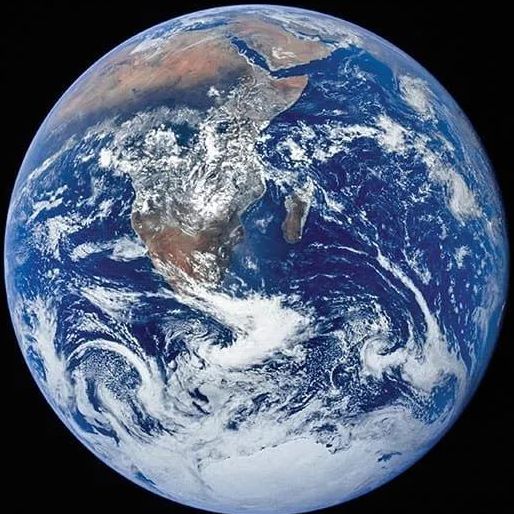
Above is the planet itself, cropped from the same frame at the full resolution of the version on this page. You can follow the coast from the Horn of Africa down past Madagascar, and see the cloud curling across the Southern Hemisphere towards the ice.
Are there newer Blue Marble photos?
Yes, NASA has reused the name. In 2002 its Earth Observatory published a new Blue Marble, a composite stitched together from four months of Terra satellite observations. Since 6 July 2015 the EPIC camera on the Deep Space Climate Observatory has sent back views of the whole sunlit Earth from about a million and a half kilometres away.
From its point between Earth and the Sun, EPIC has been sending back pictures of the full disc ever since. They are the closest thing to a daily Blue Marble, made by a machine that never blinks and never chooses its moment.
The crew who took the Blue Marble were the last people to travel that far from Earth for more than fifty years. That changed in April 2026, when the Artemis II crew flew around the Moon and brought back their own pictures of a small, round Earth. See the Artemis II photographs for those.
In the book
The NASA Photo Book prints the Blue Marble on page 103, in Era 02, The Long Look Back, which covers Apollo from 1967 to 1972. It closes the Apollo chapter, as it closed the Apollo programme.
Elsewhere
For the rest of the mission, see the Apollo 17 photographs on the Apollo VII–XVII site. There is also The Blue Marble as a print. For the photograph of Earth made by Apollo 8 four years earlier, read Earthrise, 1968, and Earthset, 2026, and for the wider canon, see the most famous NASA photographs, era by era.
Use this photograph
The original is public domain. If you use our restored version, please credit it like this and link to this page.
Photo: NASA, Apollo 17 crew. Restoration: The NASA Photo Book (thenasaphotobook.com/photos/blue-marble/)