Fourteen firsts, from a Moon caught on a silver plate in 1840 to a crew photographing Earth from behind the Moon in 2026. Each one with its date, what it showed, where the record is kept, and where it sits in the book.
By Joel Meter and Simon Phillipson. Last updated
The first photograph of Earth from space. V-2 No. 13, 24 October 1946. Photo: U.S. Army, White Sands Missile Range. Restored by Joel Meter and Simon Phillipson. The NASA Photo Book, pages 25 to 27.
In short
The first photograph of Earth from space was taken on 24 October 1946 by a 35 mm motion picture camera on a captured V-2 rocket, launched from White Sands in New Mexico to about 105 kilometres. The first picture of Earth from orbit came from Explorer 6 on 14 August 1959, and the first view of Earth from the Moon from Lunar Orbiter 1 on 23 August 1966.
Key facts
From space24 October 1946, V-2 rocket No. 13, White Sands
From orbit14 August 1959, Explorer 6
Earth from the Moon23 August 1966, Lunar Orbiter 1
By people on the Moon20 July 1969, Apollo 11, AS11-40-5866
On Mars20 July 1976, Viking 1, PIA00381
In the bookEra 00, Learning to Look, pages 18 to 33
"First" is a slippery word in the history of space photography. There is the first photograph from space, the first of the Earth from orbit, the first from the Moon, the first taken by a person rather than a machine, the first in colour. Each has a different answer, and they are easy to mix up. This page keeps them apart and puts them in order.
The rule is simple. Each entry is a dated first that is recorded by NASA or by the institution that holds the original, with a link to that record in the list of sources below. Where the photograph is in The NASA Photo Book, the page number is given. The book opens with exactly this story, in Era 00, Learning to Look.
What are the first photos from space, in order?
In date order, the firsts run from photographs of the Moon taken from the ground in 1840, to the first photograph from space in 1946 and the first from orbit in 1959, then the first view of Earth from the Moon in 1966, people photographing the Moon from its surface in 1969 and Mars in 1976.
The first photograph of Earth from space was taken on 24 October 1946 by a 35 mm motion picture camera in a captured German V-2, rocket No. 13, launched from White Sands in New Mexico. It climbed to about 105 kilometres, 65 miles. The rocket was destroyed when it fell back, but the film survived in a steel case.
What was the first picture of Earth from orbit?
The first picture of Earth taken from orbit came from Explorer 6 on 14 August 1959. A scanning photocell recorded a crude image of a sunlit, crescent-shaped part of the North Central Pacific Ocean from roughly 27,000 kilometres up. The image took some forty minutes to radio down to a ground station in Hawaii.
What was the first photo of Earth from the Moon?
The unmanned Lunar Orbiter 1 took the first view of Earth from the vicinity of the Moon on 23 August 1966, as it came around from the far side. The first Earthrise seen and photographed by people followed on 24 December 1968, when Bill Anders took frame AS08-14-2383 from Apollo 8 on its fourth lunar orbit.
What was the first photograph on the surface of Mars?
Viking 1 took the first photograph on the surface of Mars on 20 July 1976, within minutes of landing and seven years to the day after Apollo 11. NASA catalogues it as PIA00381. It shows rocks, sand and dust close up, and part of the lander's own footpad number 2, with a little sand thrown onto it.
01 / Before space
1840 and 1851
The first photographs of the Moon
Photography was barely a year old when it was turned on the sky. In March 1840 the chemist John William Draper made a daguerreotype of the Moon in New York, and he is generally credited with the first successful photograph of it. The plate is held by New York University Libraries. A decade later, at Harvard College Observatory, the photographer John Adams Whipple and the astronomer William Cranch Bond made far more detailed daguerreotypes of the Moon through the observatory's telescope, and they were shown in London in 1851. Nothing had left the ground yet, but the idea of the camera as a way to see space was already there.
In the book, Harvard Observatory, pages 20 and 23.
02 / From a rocket
24 October 1946
The first photograph of Earth from space
A captured German V-2, rocket No. 13, was launched from White Sands in New Mexico carrying a 35 mm motion picture camera. It climbed to about 105 kilometres, 65 miles, above the desert. The rocket fell back and was destroyed, but the film was sealed in a steel case and survived. Developed, it showed what no one had seen before, the curve of the planet and, above the thin bright band of the atmosphere, the black of space. The photograph shown at the top of this page is the one the book prints, restored. The credit belongs to the U.S. Army at White Sands Missile Range.
In the book, V-2 rockets, pages 25 to 27.
03 / From orbit
14 August 1959
The first photograph of Earth from orbit
Explorer 6 carried a test device, a scanning photocell meant to record Earth's cloud cover. On 14 August 1959 it produced the first picture of Earth taken from orbit, a crude image of a sunlit, crescent-shaped part of the North Central Pacific Ocean. NASA's records put the satellite at roughly 27,000 kilometres, about 17,000 miles, and the image took some forty minutes to radio down to a ground station in Hawaii. It shows almost nothing you could recognise. It matters because it was the first time a machine in orbit sent home a picture of the planet beneath it. It is not in the book.
04 / On television
1 April 1960
The first television picture of Earth from space
TIROS-1, the first weather satellite, sent back its first television picture of Earth on the day it was launched, from about 450 miles up. It carried two small television cameras of about two pounds each. The satellite worked for only 78 days, but in that time it returned around 23,000 images, most of them good enough for its real purpose, which was forecasting weather. Weather satellites have been watching the planet ever since. It is not in the book.
05 / By hand
20 February 1962
The first photographs by an American in orbit
John Glenn was the first American to orbit Earth, and he took a camera. NASA's history office describes it as an Ansco Autoset, a 35 mm camera bought in a local drugstore and hastily modified so he could use it in his pressure suit. Shortly after the spacecraft separated from its rocket, Glenn photographed Florida with it. The pictures are not remarkable on their own. What changed was the photographer. From here on, much of NASA's photography would be made by people choosing what to point the camera at.
In the book, Project Mercury, pages 40 to 48.
06 / Close to the Moon
31 July 1964
The first close-up photographs of the Moon
Ranger 7 was built to do one thing, fly straight into the Moon and photograph it on the way down. On 31 July 1964 at 13.09 UT it took the first picture of the Moon by a United States spacecraft, about seventeen minutes before impact, and then kept going. By the end it had sent back more than 4,300 images, the last of them with detail around half a metre across. Until then no close-up photograph of the lunar surface existed. The pictures helped choose the places Apollo would later land.
In the book, Ranger, pages 144 to 146.
07 / Outside
3 June 1965
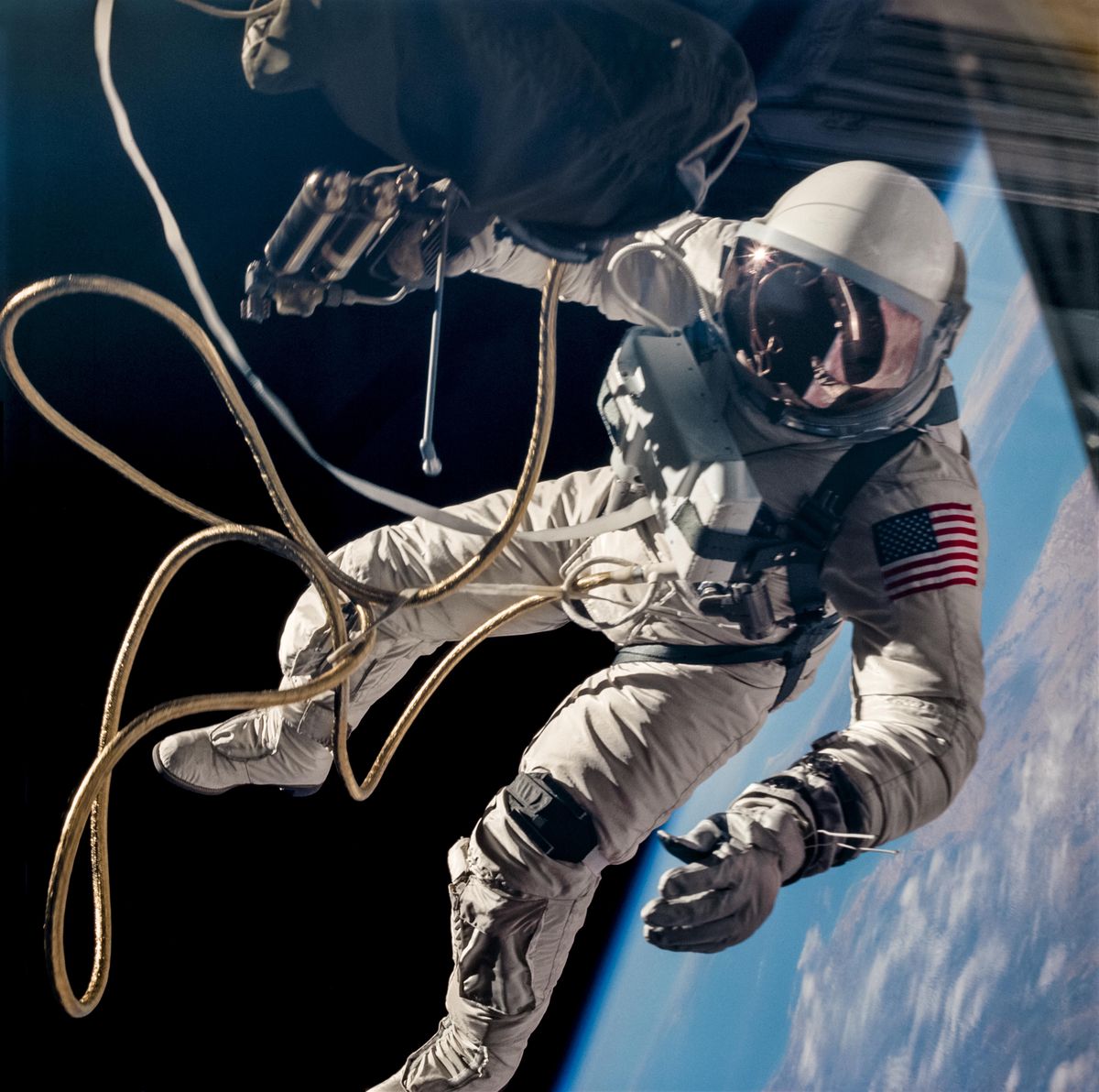
The first photographs of an American spacewalk
Ed White, the first American spacewalk. Gemini 4, 3 June 1965. Photo: NASA, James McDivitt. Frame S65-34635. Restored from the original film scan by Joel Meter and Simon Phillipson. The NASA Photo Book, page 53.
Ed White stepped out of Gemini 4 and floated on a gold-wrapped tether for a little over twenty minutes, and his commander, James McDivitt, photographed him through the window. They were the first photographs of an American in open space. NASA's catalogue lists nine frames from the walk. The best known, S65-34635, is shown here. For the full story, from the oxygen gun that ran dry to the hatch that would not latch, see Ed White, the first American spacewalk.
In the book, page 53.
08 / Another planet
14 July 1965
The first close-up photographs of another planet
Mariner 4 flew past Mars on 14 July 1965, Eastern time, the 15th in universal time, at about 9,846 kilometres. Its television camera took 21 pictures and part of a 22nd, covering about one percent of the planet. They showed craters and no canals, which ended a century of speculation in one afternoon. While the computers were still processing the first image, engineers at the Jet Propulsion Laboratory printed the numbers on strips of paper, stapled them to a wall and coloured them in by hand to see it sooner.
In the book, Mariner 4, pages 152 to 153.
09 / On the Moon
2 June 1966
The first American photographs from the surface of the Moon
Surveyor 1 landed softly on the Moon on 2 June 1966, the first American spacecraft to do so, and began sending back pictures of the ground around it. Over the following weeks it returned more than 11,000 images. They showed that the surface would hold the weight of a lander, which was the question Apollo needed answered. The Soviet Luna 9 had reached the surface first, in February the same year, so this is an American first, not a world first.
In the book, Surveyor 1, pages 147 to 148.
10 / Earth from the Moon
23 August 1966
The first view of Earth from the Moon
The first view of Earth from the Moon. Lunar Orbiter 1, 23 August 1966. Photo: NASA/LOIRP, restored from the original data tapes in 2008. The NASA Photo Book, pages 32 and 150.
Lunar Orbiter 1 was mapping the Moon for landing sites. On 23 August 1966, as it came around from the far side, it was turned to photograph Earth rising over the lunar horizon. It was not in the original plan. The picture was the first of Earth from the vicinity of the Moon, and the spacecraft repeated it two days later. The original data was never fully read out in the 1960s. In 2008 the Lunar Orbiter Image Recovery Project restored it from the original tapes on refurbished machines, and the restored version is the one in the book.
In the book, Lunar Orbiter 1, pages 32 and 150.
11 / Seen by people
24 December 1968
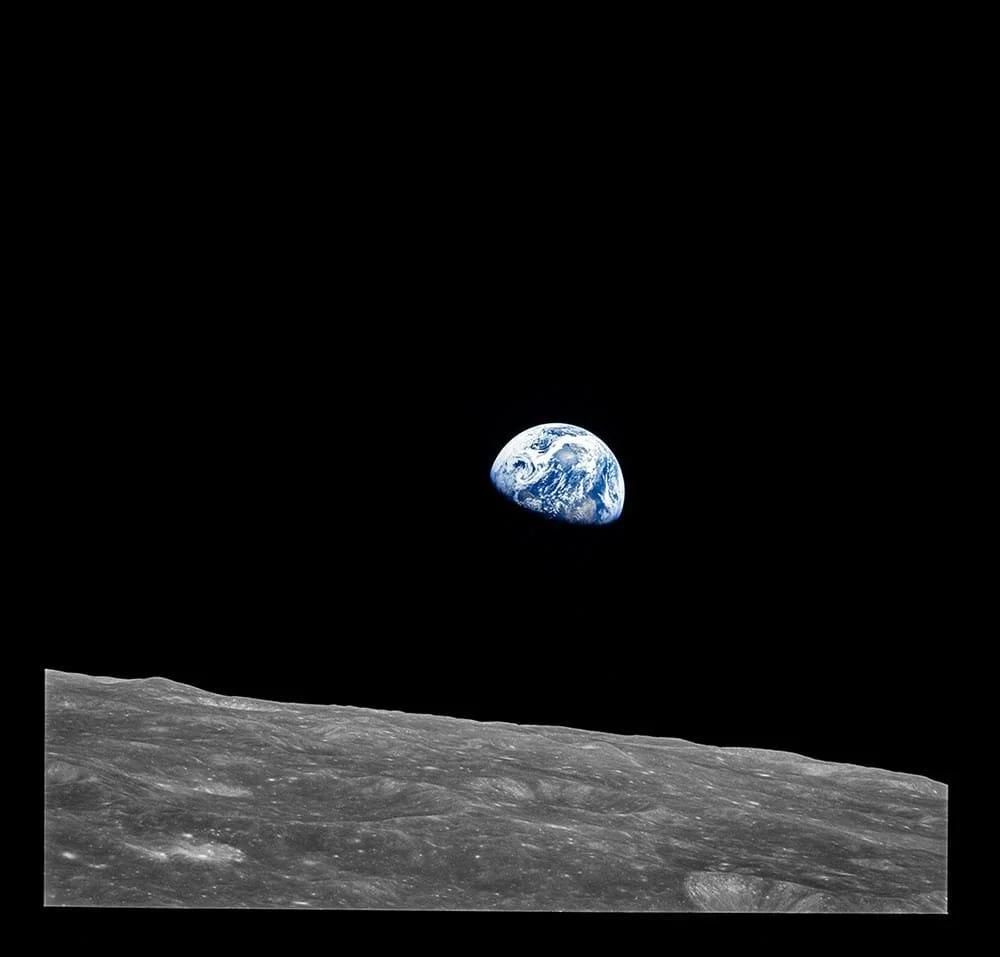
The first Earthrise photographed by people
Earthrise. Apollo 8, 24 December 1968. Photo: NASA, Bill Anders. Frame AS08-14-2383. Restored from the original film scan, as published in Apollo VII–XVII. The NASA Photo Book, pages 82 to 83.
Two years after Lunar Orbiter, three people saw the same thing with their own eyes. Coming around the Moon on their fourth orbit, the crew of Apollo 8 saw Earth rise, and Bill Anders photographed it, first in black and white and then in colour. Frame AS08-14-2383 became one of the most reproduced photographs ever made. For the full story and the 2026 photograph that answers it, see Earthrise, 1968, and Earthset, 2026.
In the book, Apollo 8, pages 82 to 83.
12 / On the Moon, by people
20 July 1969
The first photographs taken by people on the Moon
Buzz Aldrin on the porch of Eagle. Apollo 11, 20 July 1969. Photo: NASA, Neil Armstrong. Frame AS11-40-5866. Restored from the original film scan by Joel Meter and Simon Phillipson. The NASA Photo Book, pages 86 to 95.
On Apollo 11 the first photographs ever taken by people standing on another world were made with a 70 mm lunar surface camera. Early in the moonwalk Neil Armstrong turned it on Buzz Aldrin as he backed down the ladder of the lunar module Eagle, frame AS11-40-5866. Michael Collins stayed in orbit in Columbia. The famous bootprint, AS11-40-5878, is from the same magazine of film. The Apollo VII–XVII site has Apollo 11, frame by frame.
In the book, Apollo 11, pages 86 to 95.
13 / On Mars
20 July 1976
The first photograph on the surface of Mars
Seven years to the day after Apollo 11 landed, Viking 1 touched down on Mars, and within minutes it took the first photograph ever made on the surface of the planet. NASA catalogues it as PIA00381. It shows rocks, sand and dust close up, and at the right, part of the lander's own footpad number 2, with a little sand thrown onto it by the landing. The first thing a machine did on Mars was look down at its own feet.
In the book, Viking, pages 208 to 211.
14 / Back to the Moon
6 April 2026
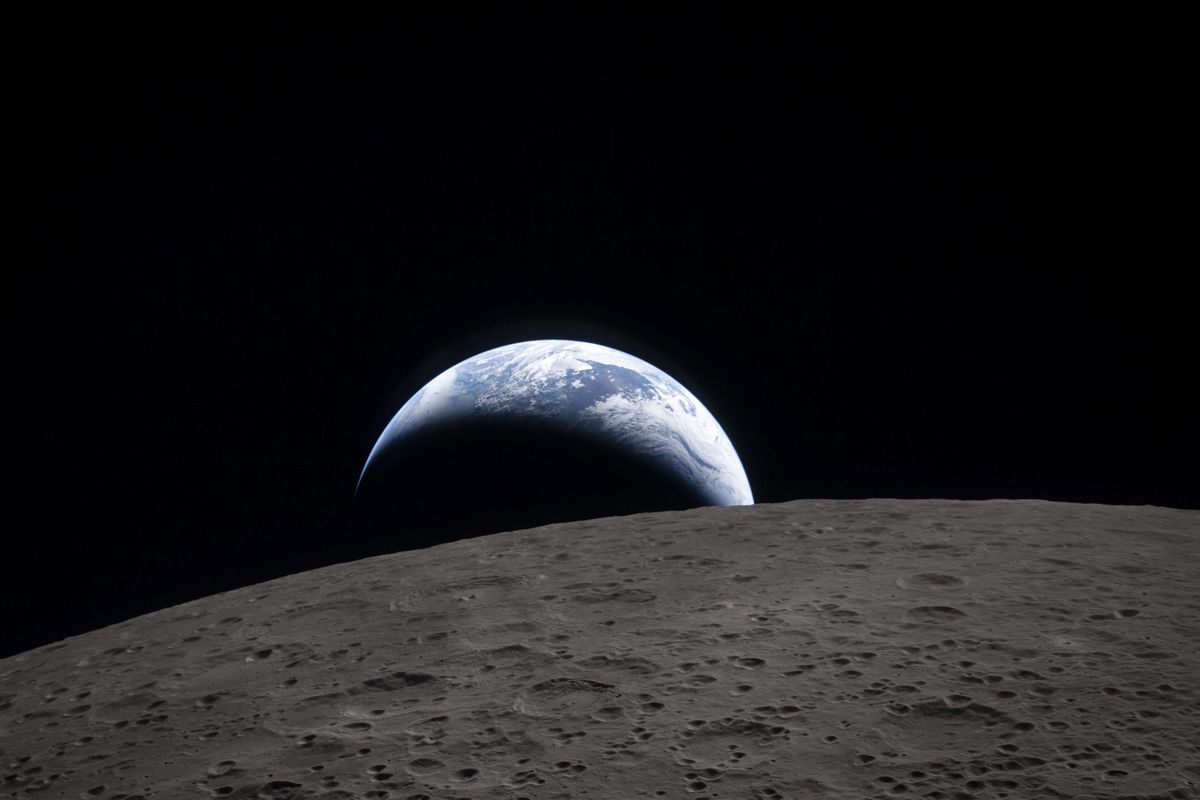
The first photographs of the far side by a crew since 1972
Earthset. Artemis II, 6 April 2026. Photo: NASA, Artemis II crew. Frame ART002E009288. Restored from the original mission data by Joel Meter and Simon Phillipson. The NASA Photo Book, pages 310 to 331.
On 1 April 2026 the Artemis II crew left Earth orbit, the first people to do so since Apollo 17. Five days later they flew around the far side of the Moon and photographed it, and photographed Earth setting behind its horizon. Frame ART002E009288, Earthset, is the closing picture of this timeline. For five of the photographs that will last, see the Artemis II photographs.
In the book, Artemis II, pages 310 to 331.
Where the book starts
The NASA Photo Book opens with this sequence, from the first photographs of the Moon to Lunar Orbiter's look back at Earth, in Era 00, Learning to Look, on pages 18 to 33. The rest of the book follows each new way of seeing to its end. For a list ordered by fame rather than by date, see the most famous NASA photographs, era by era.
The NASA Photo Book, pages 32 to 33. Lunar Orbiter 1, 23 August 1966.