Photographs / STS-41BFrame STS41B-35-1613
Bruce McCandless, flying free, 7 February 1984
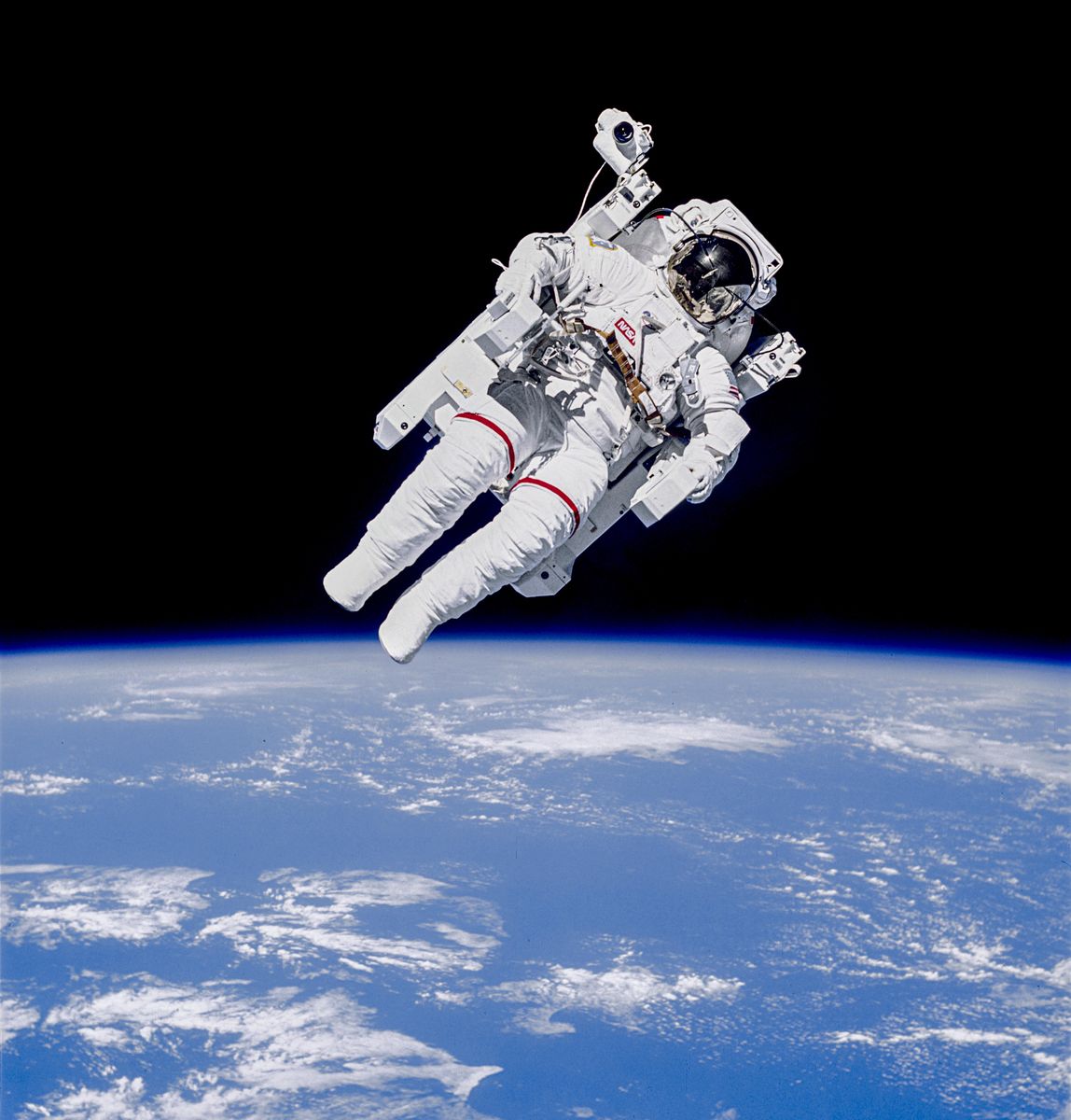
A man in a white suit, a backpack of nitrogen jets, the curve of Earth below and nothing connecting him to anything. It is the photograph on the cover of the book, and it was taken by a pilot who checked his focus four times.
By Joel Meter and Simon Phillipson. Last updated
In short
The photograph of Bruce McCandless flying free above Earth was taken on 7 February 1984, on Space Shuttle mission STS-41B, by the pilot Robert Gibson from inside Challenger. NASA catalogues it as frame STS41B-35-1613. McCandless was flying the Manned Maneuvering Unit and became the first person to move through space untethered. The photograph is the cover of The NASA Photo Book.
Key facts
- PhotographerRobert Gibson, pilot of STS-41B
- SubjectBruce McCandless, flying the Manned Maneuvering Unit
- Date7 February 1984
- MissionSTS-41B, Space Shuttle Challenger
- NASA frameSTS41B-35-1613
- CameraHasselblad
- In the bookThe cover, and page 124, Era 03, Learning to Stay
Was Bruce McCandless really untethered?
Yes. On 7 February 1984 McCandless stepped out of the payload bay of Challenger wearing the Manned Maneuvering Unit, a backpack driven by small jets of nitrogen and steered with hand controllers. Earlier spacewalkers had always been tied to their spacecraft. McCandless was not, and he became the first person to move through space untethered.
In the photograph he is a few metres from the cabin, upright, arms resting on the controllers, as if he were standing on something. He is not. He and Challenger were both travelling at about 28,160 kilometres an hour, and what looks like stillness is two objects moving at the same speed side by side. The calm in the picture is the calm of good engineering. He nudged the thrusters only to hold his place beside the shuttle.
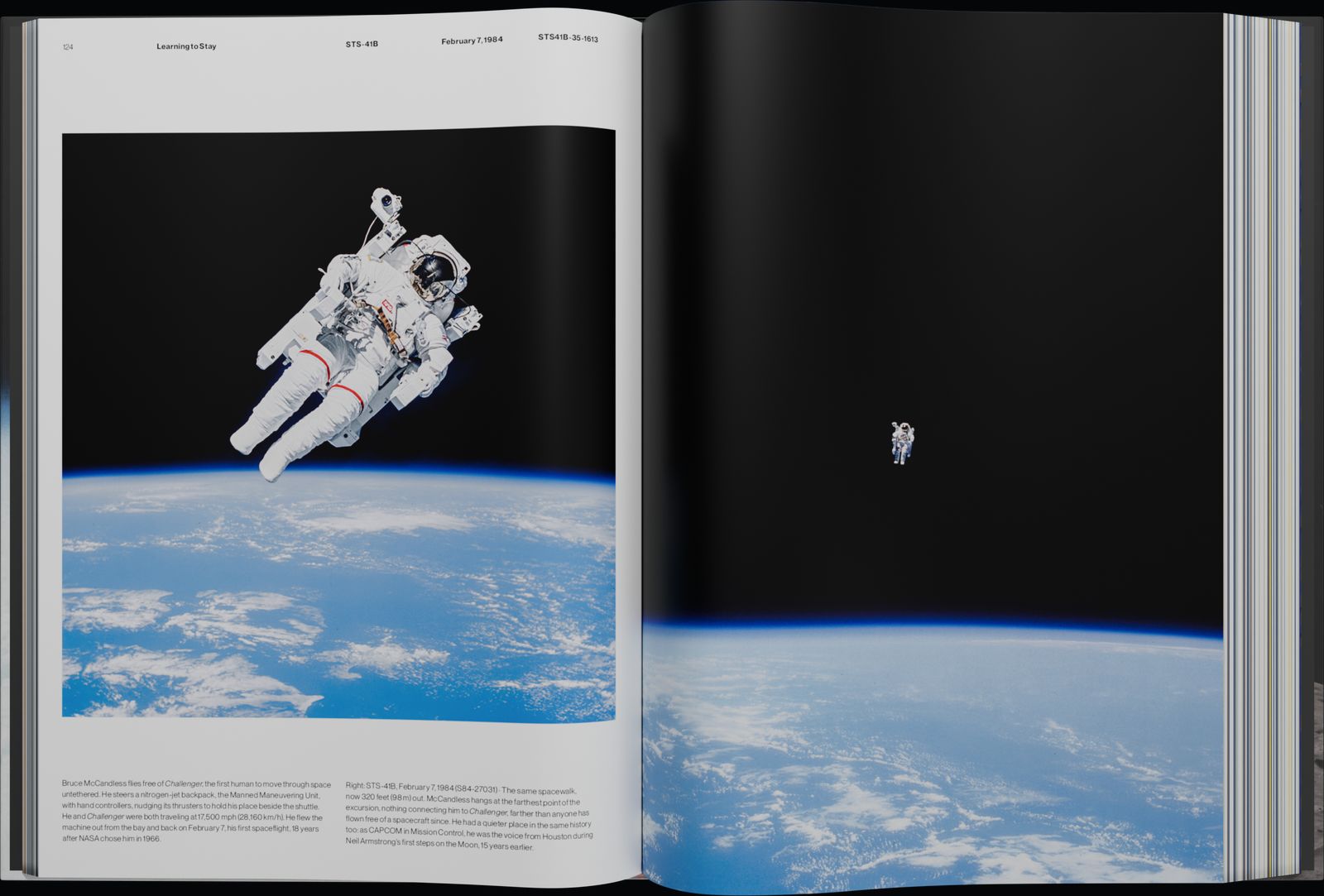
Later in the same excursion he flew out to about 98 metres, the farthest point of the flight. A second NASA frame, S84-27031, shows him there, a tiny white figure against black space with Earth along the bottom of the frame. The book prints the two side by side.
It was his first spaceflight. NASA had selected him as an astronaut in 1966, eighteen years earlier. In between he had been, among other things, the voice from Houston as CAPCOM when Neil Armstrong took his first steps on the Moon.
Who took the famous photo of Bruce McCandless?
Robert Gibson, the pilot of STS-41B, took the photograph from inside the cabin of Challenger. NASA's history office describes how he did it. While McCandless was outside, Gibson picked up a Hasselblad, took three light meter readings and checked his focus four times for each photograph. NASA catalogues the frame as STS41B-35-1613.
The same flight produced a series of frames of the excursion, made by the crew inside, Vance Brand, Robert Gibson and Ronald McNair, while Robert Stewart, the second spacewalker, also took a turn with the unit. Many reproductions online carry no photographer at all, or credit the picture simply to NASA, which is why the name is worth repeating here.
Why is McCandless on the cover of The NASA Photo Book?
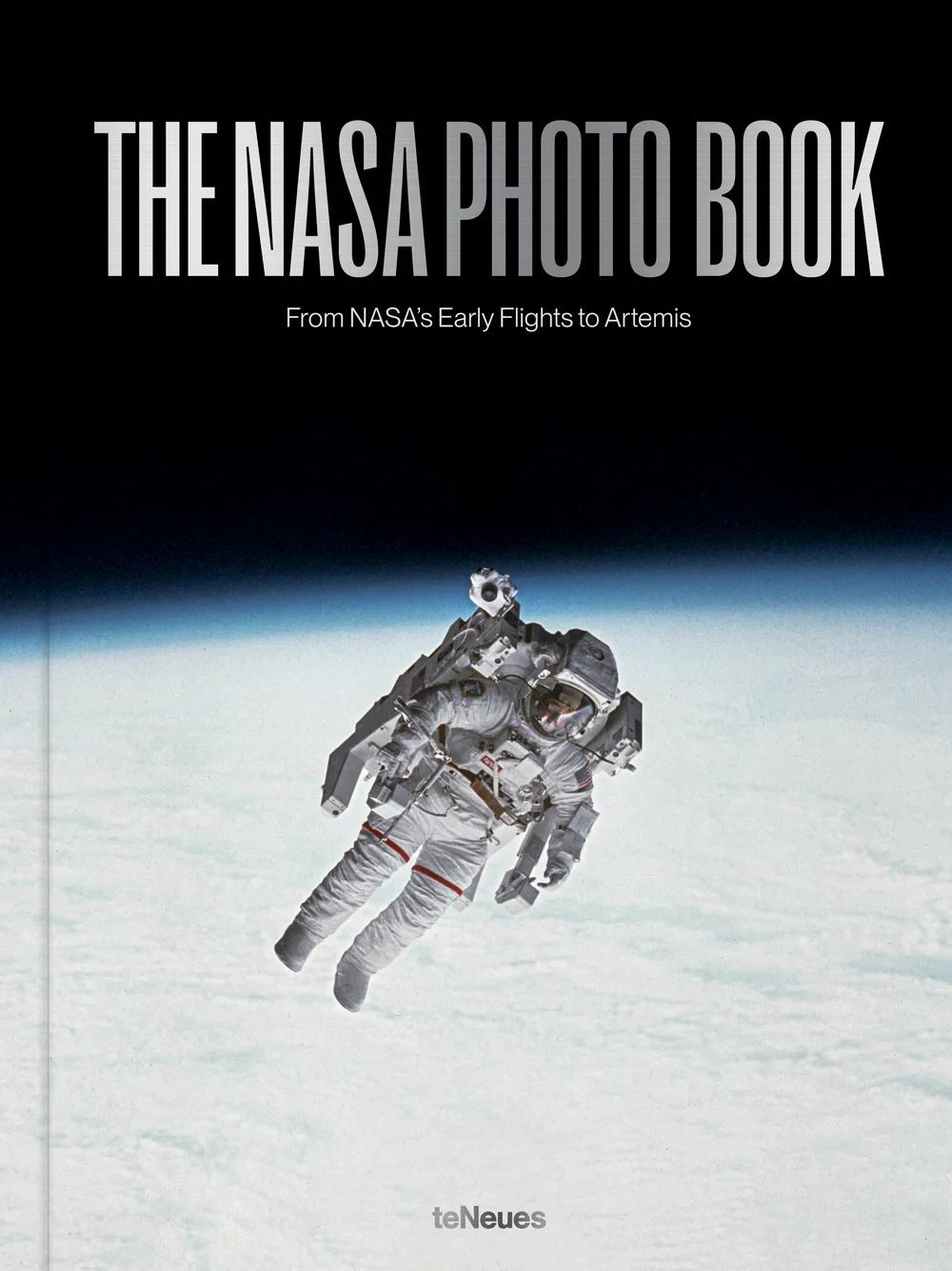
It works as a cover for the same reason it works as a photograph. There is one figure, one horizon and a great deal of black, and you can read it from across a room. On the cover of The NASA Photo Book the photograph runs edge to edge, with the title printed above it in silver foil.
The book's press release puts it simply. The pictures the world knows are all in the book, Earthrise and the Blue Marble, the first bootprint, Jupiter's storms, and Bruce McCandless's untethered spacewalk on the cover. The photograph also says something about the book without a word of text. This is a photograph made by one person of another, far from home. The authors write of the grain in their restorations that it is the proof that someone was really there, holding a camera. Here you can see both people, one in the frame and one implied by it.
Restored
The restoration started from a scan of the original film. Like every photograph in the book it was cleaned of dust, scratches and fading, with nothing added that was not on the film. A frame like this has detail at both ends of the range, in the folds and stitching of a white suit lit by full sunlight and in the dark machinery of the backpack against black space. The grain of the film stays in, as it does everywhere in the book.
What happened to the Manned Maneuvering Unit?
NASA built two flight units. They flew on three Shuttle missions in 1984, 41-B in February, 41-C in April and 51-A in November, carried by six astronauts on nine sorties that added up to ten hours and twenty-two minutes. After that the backpack was retired, and astronauts went back to tethers and the Shuttle's robotic arm.
On 41-C and 51-A the backpack was used to reach satellites. On McCandless's own flight, Robert Stewart took a turn with the same unit later in the excursion, and two days later the pair tested the second unit.
The backpack that eventually followed, the Simplified Aid for EVA Rescue, or SAFER, is a small emergency unit meant to bring a drifting astronaut back, not a way of getting around. No one has flown free of a spacecraft farther than McCandless did that day.
In the book
The photograph is the cover of The NASA Photo Book and appears again on page 124, opposite the same spacewalk at its farthest point. It belongs to Era 03, Learning to Stay, in the Space Shuttle section on pages 119 to 127.
Elsewhere
For the first American to leave a spacecraft, nineteen years earlier and on a gold-wrapped tether, see Ed White's spacewalk on Gemini 4. For the wider canon, see the most famous NASA photographs, era by era.
Use this photograph
The original is public domain. If you use our restored version, please credit it like this and link to this page.
Photo: NASA, Robert Gibson. Restoration: The NASA Photo Book (thenasaphotobook.com/photos/mccandless-untethered-spacewalk/)